
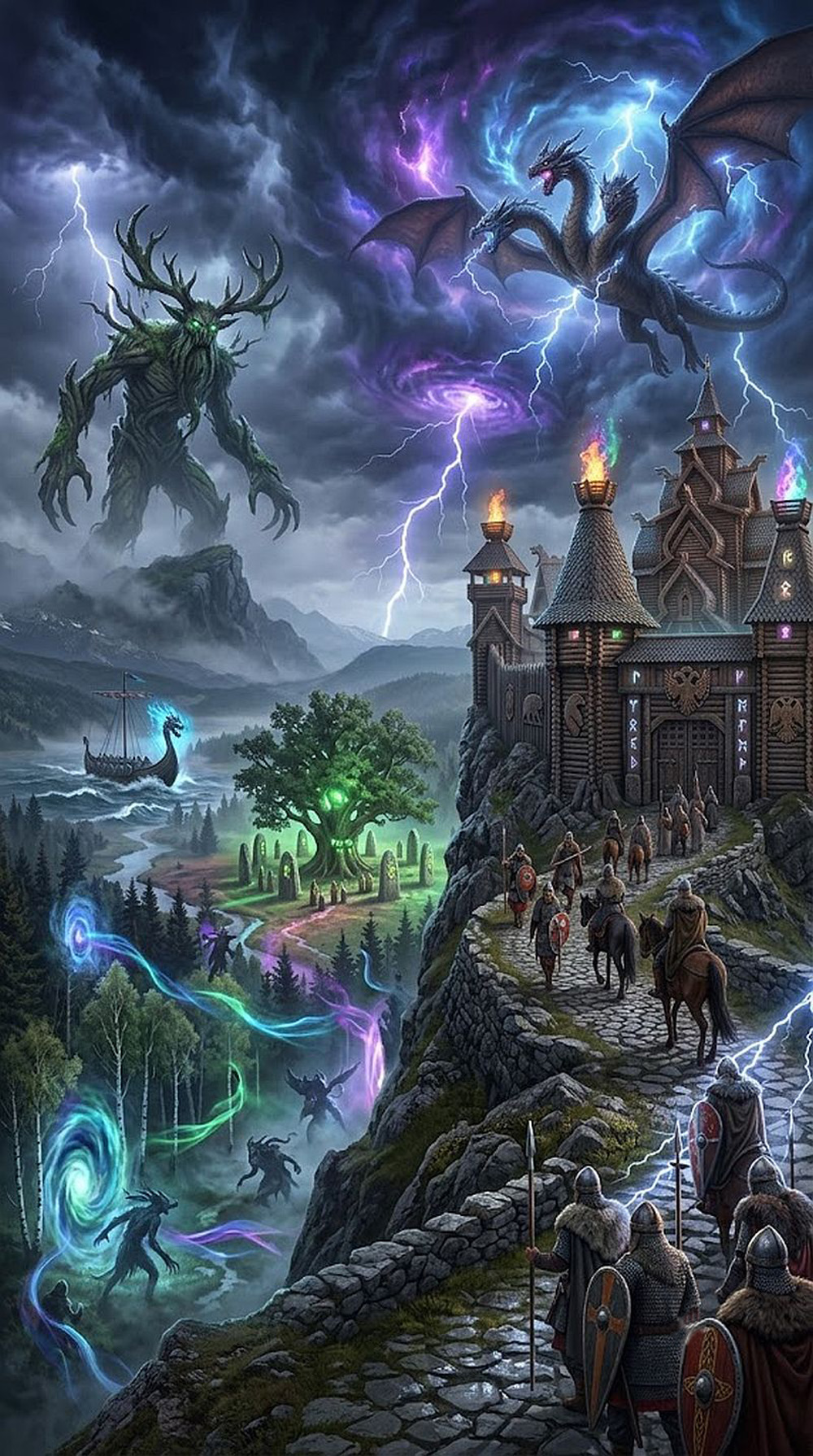
From the thunder god Perun to the black dragons of L’ven, a deep-dive into the mythological tradition powering the most distinctive fantasy being written today.
When most Western readers think of mythology in fantasy, they think of Greece. Zeus on Olympus. Thor in Asgard. The neat, well-documented pantheons of classical civilization, their stories catalogued by ancient historians and repackaged by generations of fantasy authors into something familiar, orderly, and ultimately safe.
Slavic mythology is none of those things.

It is fragmentary. Contradictory. In many places deliberately suppressed, the Christianization of Slavic lands from the 9th century onward meant that the old gods were not catalogued and preserved the way Greek or Norse gods were; they were demonized, forgotten, or forced to survive in fragments of folklore, folk magic, seasonal rituals, and the oral traditions of rural communities. What we have is incomplete. What we have is haunting. And what we have is, for a fantasy author willing to work with it seriously, one of the most powerful mythological traditions on earth.
This is a complete reader’s guide to epic fantasy inspired by Slavic mythology: what the tradition actually contains, why it produces such distinctive fantasy, how its gods and creatures and cosmological structure differ from anything else in the genre, and which books handle it with the depth and seriousness it deserves.
Understanding Slavic Mythology
The Problem of Sources
The first thing to understand about Slavic mythology is that we are working with fragments. Unlike Greek mythology, preserved in Homer and Hesiod and hundreds of dramatists and philosophers, or Norse mythology, recorded in Snorri Sturluson’s Prose Edda and the poems of the Elder Edda, the pre-Christian mythology of the Slavic peoples survives primarily in:
Chronicles written by Christian missionaries and monks who were documenting what they were trying to replace, and therefore hostile interpreters
Folklore collected from the 18th century onward, by which point Christianity had been layered over the tradition for eight or nine centuries
Comparative mythology, scholars working backward from Baltic, Germanic, and Indo-European parallels to reconstruct what might have existed
Place names, personal names, and regional traditions that preserved mythological fragments without always understanding what they preserved…

This fragmentary nature is not a weakness. For fantasy authors, it is an invitation. The gaps in the record are creative space. The contradictions between regional traditions, Polish, Czech, Slovak, Croatian, Serbian, Bulgarian, Ukrainian, Russian all have their own versions, mean there is no single “correct” Slavic mythology to get wrong. There is only the tradition, in all its variation, to work with respectfully and imaginatively.
The best Slavic mythology fantasy series embrace this: they do not pretend to reconstruct a lost sacred text. They use the tradition as living material, the way every mythology has always been used, as a framework for understanding the world, adapted to the needs of the story and the time.
The Slavic Gods: A Pantheon Unlike Any Other
The Slavic pantheon is not tidy. There is no single authoritative list of gods, no canonical genealogy, no unified cosmology. Different Slavic peoples worshipped different deities, and the same divine function was often served by different names in different regions. What follows is a synthesis of the most significant figures and what they represent, the tradition that serious Slavic fantasy draws from.
Perun, The Thunderer
Perun is the closest Slavic mythology comes to a chief deity in the manner of Zeus or Odin. He is the god of thunder, lightning, mountains, oak trees, and war. His weapon is an axe or a hammer (the specifics vary by region). His symbol is the oak.
But Perun is defined less by dominion than by conflict. His essential nature is expressed through his eternal struggle with Veles, a cosmic battle that recurs seasonally and structures the Slavic mythological world more than any hierarchy of gods. Perun represents the sky, the high places, the ordered and the martial. His opponent is equally important.
Veles, The Underworld Serpent
Veles is one of the most complex figures in Slavic mythology, and arguably the most interesting for fantasy purposes. He is the god of the underworld, of cattle and livestock, of wealth, of magic, of the arts, and of the dead. He is associated with serpents and with the roots of the World Tree (as opposed to Perun, who lives in its crown).
The critical point: Veles is not evil. He is the necessary dark half of a cosmic balance. In the eternal conflict between Perun and Veles, Veles is not the villain, he is the principle of chthonic depth, of the wet and the fertile and the hidden, as opposed to Perun’s sky-principle of the dry and the high and the visible. The cattle stolen from Perun are restored. The seasons turn. The battle is not won; it is repeated.
This is the theological sophistication that distinguishes Slavic mythology from simpler good-versus-evil cosmologies, and it is what gives the best Slavic fantasy its moral complexity.
Mokosh, The Weaver of Fate
Mokosh (also Mokoš) is the only major Slavic goddess whose existence is attested by primary sources across multiple regions. She is the goddess of fate, weaving, women’s work, moisture, and the earth. She is associated with sheep (whose wool is woven), with spinning (the thread of fate), and with the harvest.
Her role in Slavic cosmology is profound: she is the weaver who determines destiny. In folk tradition that survived Christianization, she was syncretized with the Virgin Mary, a measure of how deeply embedded she was in the culture. In fantasy terms, she represents the tradition of fate-as-craft: destiny is not simply declared, it is made, thread by thread, by a goddess who has been weaving since before the world began.
Črt (Chort), The Adversary
Črt is the Slavic devil, but a devil with pre-Christian roots that make him more complex than his later Christian interpretation suggests. He is the god of evil, chaos, and darkness, associated with the underworld in its most malevolent aspect. In South Slavic tradition, Črt (or Črt) is specifically associated with the lower underworld, with demons, and with the active force of destruction in the world.
His demons, the creatures of Črt’s realm, are not merely metaphors. They are beings with agency, power, and a relationship with mortals who are willing to seek them out. In Slavic folk magic, the boundary between seeking Veles’s wisdom and making pacts with Črt’s demons was permeable and dangerous, a distinction preserved in the best Slavic fantasy magic systems.
Svarog, The Forge God
Svarog is the god of fire and the celestial forge. His children include Svarozhich (the fire spirit) and Dazbog (the sun). He represents the divine craftsman principle, the god who made the world by shaping it, who gave humanity the gift of fire and metalworking. In some traditions, Svarog is a creator deity; in others, he is the divine smith who works within a created world.
Mokosh’s Sisters: Dolya and Nedolya
Among the most interesting figures for fantasy purposes are the twin personifications of fate that attend Mokosh’s work: Dolya (Good Luck, or the Good Fate) and Nedolya (Bad Luck, or the Bad Fate). Each person is assigned a Dolya or a Nedolya at birth, a personal spirit of fortune that follows them through life. This is not destiny in the Greek tragic sense. It is something more intimate: a companion who is, by nature, either your ally or your obstacle, and whose assignment is not your doing and not always your desert.
This concept, personal spirits of fortune assigned at birth, beyond individual control, is the kind of mythological specificity that distinguishes genuine Slavic fantasy from generic “Slavic-flavored” work.
The Cosmology: The World Tree and Three Realms
The Slavic cosmos is structured around the World Tree, an enormous oak (or, in some traditions, an ash or a birch) whose roots reach into the underworld realm of Nav (the land of the dead), whose trunk passes through Yav (Javija, the world of the living), and whose crown reaches into Prav (the divine realm, the sky world).
This is not unique to Slavic mythology, the World Tree appears in Norse myth as Yggdrasil, in many Indo-European traditions. What is distinct is how the Slavic version structures the divine conflict: Perun in the crown, Veles at the roots, eternally opposing each other through the length of the tree. The whole of human experience takes place between them, in the middle realm. But this is just one version.
The three realms, Prav, Yav, Nav, provide Slavic fantasy with a cosmological architecture that has immediate dramatic utility. The boundary between Yav and Nav is permeable. The dead are not far away. The underworld is not a prison but a parallel world with its own logic and its own ruler who takes his role seriously. This is the mythological basis for the Slavic tradition’s relationship with death and the dead: not terror, but a structured relationship with those who have crossed to the other side.
The Creatures: Where Slavic Folklore Gets Strange
The creature tradition of Slavic mythology is one of the richest and most distinct in world folklore. These are not the sanitized fairy creatures of Victorian England or the generic fantasy monsters of D&D handbooks. They are specific, regional, ancient, and deeply strange.
Drekavac (Drekavatz): The shrieking spirit. In South Slavic tradition, the drekavac is the soul of an unbaptized or otherwise improperly buried child. It shrieks in the night with a sound like a screaming child or a howling animal. It is associated with disease and with ill omen. It cannot be placated by ordinary means. The drekavac represents the specific Slavic horror of improper death, of lives cut short in ways that prevent proper passage to Nav, leaving souls trapped and screaming in Yav.
Rusalka: In the most widespread tradition, the rusalka is the spirit of a woman who died by drowning or before her wedding, another improperly completed life. She lives near water, is beautiful and dangerous, and drowns men. In some regional traditions, she is primarily a spirit of fertility and agricultural abundance. In others, she is purely predatory. The contradiction is the point: the rusalka embodies the way femininity is mythologized in Slavic tradition, simultaneously generative and lethal, tied to water and to frustrated desire.
Domovoi: The household spirit. Every home has one. It protects the family, lives behind or beneath the stove, and must be treated with respect: fed, acknowledged, spoken to correctly. An honored domovoi keeps the family safe. An offended domovoi causes illness, tangles hair, spoils food, and drives the cattle mad. The domovoi is among the most democratic of Slavic spirits, every family has one, not just the noble or the magical, and represents the deeply practical Slavic mythological tradition: the supernatural is not something that happens to exceptional people. It is woven into daily life.
Leshy: The spirit of the forest. The leshy is not simply a nature spirit in the mild, Tolkienian sense. It is the forest itself with agency, a being that leads travelers astray, that can mimic voices, that shapeshifts between a tiny mushroom and a giant taller than the treetops. To pass through the forest safely is to negotiate with the leshy, and the leshy drives a hard bargain.
Kikimora: A spirit of nightmares and domestic disruption, sometimes described as the wife of the leshy, sometimes as an independent entity. The kikimora enters homes through keyholes, tangles thread and yarn, causes bad dreams, and smothers sleeping children. She is the dark inverse of the domovoi, where the domovoi protects the household, the kikimora destroys it.
Baba Yaga: The most famous figure in Slavic folklore. Baba Yaga is impossible to categorize as simply good or evil. She lives in a hut on chicken legs at the boundary between the living world and the dead. She tests heroes. She eats those who fail. She gives crucial gifts to those who pass her tests with the right combination of cleverness, politeness, and courage. She is the guardian of the threshold, the crone who knows everything, the figure who must be overcome, not defeated in battle but navigated, outwitted, appeased. She is one of the great figures in world mythology: a woman of absolute power who is neither villain nor ally but something stranger and more useful than either.
The Slavic Giants: Among the most distinctly regional figures in South Slavic mythology are the ancient giants, enormous beings associated with specific mountains, rivers, and geographical features. These include Stribor (the wind spirit), Svitogor (the world-giant), Troglav (the three-headed), Regoč, Koleda, and many others whose names survive in place names and regional tradition. They are not simply large humans. They are mythological forces personified, older than the gods in some traditions, part of the world’s structure rather than its governance.
How Slavic Mythology Shapes Epic Fantasy
The Theological Architecture of Good and Evil
The most important thing Slavic mythology gives epic fantasy is a non-binary theological architecture.
In most Western fantasy derived from Christian tradition, good and evil are absolute opposites. The Dark Lord is evil because evil is a thing that exists, personified. The heroes are good. The war between them is cosmic and total.
Slavic mythology does not work this way. Veles is not evil. Darkness is not the enemy of light, it is its necessary complement. The dead are not simply “bad” or to be feared; they are part of a structured relationship with the living, mediated by beings who have their own rules and their own dignity. Even Črt, the Slavic devil, is more complex than his Christian interpretation suggests, he is the destructive principle, not the simply malevolent one.
This gives Slavic epic fantasy its characteristic moral complexity. Heroes are not simply heroic. Villains have reasons that are sometimes right. The cosmos is not designed to guarantee that good wins, it is designed to continue, through the eternal cycling of conflict and resolution, death and return, winter and summer.
Magic as Relationship, Not Power
In Slavic folk tradition, magic is never a neutral tool. It is always relational. You do not simply learn spells and cast them. You enter into relationships, with spirits, with gods, with forces older than civilization, and those relationships have obligations attached. The magic you receive is commensurate with what you give, what you are, and who you have made yourself into through your choices and your devotions.
This translates directly into the best Slavic fantasy magic systems: magic that costs something real, that reflects the character using it, that carries moral weight because it carries mythological weight.
Fate as Active Force
The Slavic tradition of Dolya and Nedolya, personal spirits of fortune, and of Mokosh’s weaving give fate an active, present quality that differs from Greek or Norse fate traditions. In Greek myth, the Moirai cut the thread at a predetermined moment; your fate is a fixed point you are moving toward. In Slavic tradition, fate is being woven right now, by a goddess who is still working, and the quality of that weaving reflects the choices being made by the person it concerns.
This is a subtle but important distinction: Slavic fate is not a prison. It is a process. And that process gives fantasy characters genuine agency within a mythologically structured world.
The Books, Slavic Mythology Fantasy Series Ranked by Mythological Depth
The Fifth God Saga, Dalibor Kovačec – The Gold Standard for Mythological Architecture
For readers seeking epic fantasy that takes Slavic mythology seriously as a theological and cosmological system, not just as flavor, the Fifth God Saga by Croatian author Dalibor Kovačec is the most significant recent work in the tradition.
The world of L’ven is built on a four-god cosmological structure that maps directly onto authentic Slavic mythological tradition while transforming it into something specifically fictional:
Albin is the god of light, goodness, and healing, drawing from the tradition of Svetovid, the four-faced Slavic sun god of war, light, and divination worshipped at the great temple of Arkona on the island of Rügen before its destruction by Danish crusaders in 1168. Svetovid was one of the most widely venerated Slavic deities, a god whose four faces looked in all directions simultaneously, who held a drinking horn whose fullness prophesied the coming harvest. In L’ven, Albin inherits this solar and prophetic dimension: his priests can heal through faith, they can see what others cannot, and their power is proportional to the purity of their devotion, a direct reflection of how Slavic priestly traditions understood the relationship between divine power and human virtue.
Fera, the goddess of nature and balance, draws from the tradition of Mokosh, the great mother goddess, the weaver of fate, the divine feminine principle of earth and moisture and the generative forces of the world. Fera governs nature’s balance in L’ven as Mokosh governs the weaving of fate in authentic tradition: neither good nor evil, maintaining equilibrium rather than championing a side. Her druids hold to a doctrine of balance that directly reflects the Slavic mythological sense that nature is not benevolent or malevolent but structural, it simply is, and woe to those who upset its balance.
Torvus, the god of darkness and the underworld, draws from both Veles and Črt, the two underworld figures of Slavic tradition whose distinct roles sometimes blur in folk transmission. As ruler of the demons of Črt, Torvus represents active evil and cosmic destruction; as lord of the underworld, he holds the chthonic power that Veles commands in authentic mythology. The witches and warlocks who draw power from Torvus do so through rituals that require genuine sacrifice and genuine moral commitment, you cannot take Torvus’s power while remaining good. This reflects the authentic Slavic understanding that to traffic with the forces of the underworld is a choice with permanent consequences.
Dubia, the goddess of magic itself, the most distinctive of the four, draws from the tradition of Gamajun (Gamayun), the prophetic bird-spirit of Eastern Slavic mythology whose name means “to speak obscurely” and who represents fate, knowledge, and divine communication. Gamajun sits at the edge of the world, half-bird and half-woman, knowing everything and speaking in riddles. In L’ven, Dubia is the goddess who provides magic to sorcerers not through ritual or prayer but inherently, she is the principle of magical knowledge itself, which exists in the world and can be accessed by those with the training, regardless of their moral character. This moral neutrality of sorcery is one of the saga’s most interesting theological choices, and it maps directly onto the Slavic mythological understanding of magic as a form of knowledge that is neither good nor evil but deeply dependent on who possesses it.
The Fifth God himself, the ancient, forgotten deity whose arrival Hagala seeks to force, is the catastrophic principle, the divine force of chaos that Slavic cosmology keeps in check through the eternal cycling of Perun and Veles, through the weaving of Mokosh, through the structural balance that all of existence works to maintain. His arrival would not simply be destructive. It would be cosmologically destabilizing, the end of the cycle itself, not just a bad thing happening in the world but the world’s underlying structure breaking down.
The Giants of L’ven
Particularly striking is Kovačec’s use of the ancient Slavic giants. L’ven is home to figures drawn directly from South Slavic mythological tradition:
Stribor, the Slavic wind spirit, one of the few giants whose name appears in the oldest Slavic chronicles, associated with storms and the forces of air
Svitogor, the world-giant of East Slavic byliny (epic folk poems), whose enormous strength is described as exceeding even the gods’ capacity to contain it
Klek, named for the distinctive Croatian mountain whose jagged silhouette has been mythologized as a petrified giant throughout regional tradition
Troglav, the three-headed giant, whose name means literally “three-headed” and whose worship is attested in Dalmatian Slavic tradition before Christianization
Koleda, the figure of the winter solstice ritual, the old being whose ceremonial “death” and “rebirth” each year enacted the cosmic cycle of the seasons
Regoč, from Croatian folk tradition, the giant of enormous physical power whose stories survive in regional legend
Kornat, Leđan, Ognjan, Orjen, Snježana, Snježnik, Magleni, figures from the deep landscape mythology of the South Slavic world, their names meaning “Horn Mountain,” “Ice,” “Fire,” “Orjen mountain,” “Snow woman,” “Snow mountain,” and “Misty”, a whole cosmological taxonomy of geographical and meteorological forces rendered as divine beings
These are not invented fantasy names with a Slavic sound. They are the actual ancient figures of the tradition, placed in a world that understands their nature and uses them accordingly. This is the level of mythological scholarship and cultural authenticity that distinguishes Kovačec’s work from fantasy that borrows Slavic surface texture without engaging the tradition’s substance.
The Creatures of L’ven
Alongside the gods and giants, the world of L’ven populates itself with the actual creatures of Slavic folklore: drekavac (the shrieking spirit of an improperly buried child), moguts (shapeshifting spirits), vivers (supernatural cave creatures), water nymphs, silver fairies, will-o’-the-wisps, and treants. These are not decorative additions. They are beings whose presence in the world reflects the mythological logic of L’ven’s structure: a world where the boundary between the living and the spirit realm is permeable, where the old things have not gone away, and where the ancient compact between humans and the powers of the natural world must be maintained or it will break with consequences.
The books are available in ebook and print through Amazon, Barnes & Noble, Kobo, Waterstones, Lulu.com, and many other retailers. The recommended reading order is Black Dragons, then Magic of the Soul, then the forthcoming The Gate. More at daliborkovacec.com.
The Bear and the Nightingale, Katherine Arden
Russian Cosmology Done Right
Arden’s Winternight Trilogy handles the Russian branch of Slavic mythology with genuine depth. The household spirits, domovoi, dvorovoi, bannaya, are not decorative; they are functional parts of a theological system that the characters live inside. The Bear (Medved) and Morozko (the frost demon) are not simply antagonist and love interest; they are the embodiment of the eternal Perun-Veles conflict, the sky-god and the underworld-power, translated into a Russian medieval setting.
What Arden does exceptionally well is the cosmological texture of the everyday. In authentic Slavic tradition, the mythological world is not separate from daily life, it is the structure within which daily life occurs. The domovoi matters as much as the harvest. The rusalka in the river is a practical concern, not a legend. Arden captures this integration: her protagonist Vasilisa does not seek out the magical. She was born able to see what has always been there.
Best for: Readers who want the Russian branch of Slavic mythology with literary ambition and atmospheric precision.
Uprooted and Spinning Silver, Naomi Novik
Fairy Tale Mythology at Novel Scale
Novik works with the narrative layer of Slavic mythology, the fairy tale tradition, rather than the theological layer. Her mythology is not a cosmology but a story-grammar: the rules by which Slavic fairy tales operate, their logic of testing and transformation and the terrible cost of magic.
In Uprooted, the Wood operates with the logic of the dark forest in Slavic tradition: not simply a place but an active force with its own desires, its own logic of corruption. The fairy tale structures, the deal, the transformation, the trial, carry genuine mythological weight because Novik understands the tradition she is working with.
Best for: Readers who want the fairy tale mythology tradition rather than the cosmological or theological tradition.
The Witcher Saga, Andrzej Sapkowski
Polish Folklore as World-Texture
Sapkowski uses Polish folklore primarily as texture rather than architecture. The creatures of The Witcher, the striga, the nekker, the leshy, are drawn from Polish folk tradition and handled with respect and specificity. But the cosmological structure of Geralt’s world is not Slavic: it owes more to high fantasy conventions than to the actual theological architecture of the Slavic mythological tradition.
This is not a criticism. It is a choice that serves the story Sapkowski wanted to tell: a cynical, human-focused story where monsters are metaphors and the supernatural is primarily interesting as a way to examine human nature. The Slavic mythological texture enriches this story enormously without being its foundation.
Best for: Readers who want Slavic folkloric creatures and atmosphere within a more familiar high fantasy structure.
Shadow and Bone / Six of Crows, Leigh Bardugo
Russian Aesthetic, Limited Mythology
Bardugo’s Grishaverse draws on Russian aesthetic and historical atmosphere rather than Russian mythology. The Grisha magic system (the Small Science) is original to Bardugo and does not have deep Slavic mythological roots. The world’s geography and culture evoke Tsarist Russia, but the theological structure is a standard fantasy binary.
Best for: Entry-level Slavic-flavored fantasy with high production values. Not for readers seeking deep mythological engagement.
Reading Guide, Finding Your Entry Point If You Are New to Slavic Mythology
Begin with the fairy tale tradition: Naomi Novik’s Uprooted is the most accessible entry, written in a voice that feels like a fairy tale while functioning as a novel. Then read Katherine Arden’s The Bear and the Nightingale to understand how the deeper mythological tradition operates in a realistic setting. By then, you will have the context to read The Fifth God Saga and understand what Kovačec is doing with the tradition at the level of cosmological architecture.
If You Are Already Familiar With Slavic Mythology
Go directly to The Fifth God Saga. The identification of Albin with Svetovid, Fera with Mokosh, Torvus with Črt and Veles, and Dubia with Gamajun will be immediately legible to you, and the depth of Kovačec’s engagement with South Slavic tradition, particularly his use of the giants and the creature roster, will be a genuine pleasure. This is a series written from inside the tradition, not from outside it.
If You Want the South Slavic Tradition Specifically
The Fifth God Saga is currently the most significant work drawing on Croatian and broader South Slavic mythology. The North and East Slavic traditions (Polish, Russian, Ukrainian) have more English-language representation through Sapkowski, Arden, and Novik. The South Slavic tradition, with its specific creatures (drekavac, vivers, moguts), its giant mythology (Stribor, Troglav, Klek, Svitogor), and its distinctive theological figures, is less represented in English-language fantasy outside Kovačec’s work.
If You Want Epic Scale With Mythological Depth
The Fifth God Saga is again the primary recommendation. The series operates at the scale of classic epic fantasy, multiple continents, multiple races, massive armies, world-ending stakes, while maintaining mythological depth that most epic fantasy sacrifices for scope. The challenge of Kovačec’s achievement is precisely this combination: the mythology is not ornamental but structural, and the epic scope is not pursued at the cost of the world’s mythological integrity.
Frequently Asked Questions
What is the most accurate Slavic mythology fantasy series?
For South Slavic mythology specifically, The Fifth God Saga by Dalibor Kovačec is the most mythologically grounded, drawing on the actual gods (Svetovid as Albin, Mokosh as Fera, Črt as Torvus, Gamajun as Dubia), giants (Stribor, Svitogor, Troglav, Klek, Regoč, Koleda), and creatures (drekavac, moguts, vivers) of the authentic tradition. For Russian mythology, Katherine Arden’s Winternight Trilogy is the standard. For Polish folklore, Andrzej Sapkowski’s The Witcher.
Who is Gamajun in Slavic mythology?
Gamajun (also Gamayun) is a prophetic bird-spirit from East Slavic mythology, a creature depicted as half-woman, half-bird, sitting at the edge of the world. Her name means “to speak obscurely” and she represents fate, divine knowledge, and prophecy. She knows all things and speaks in riddles. In The Fifth God Saga, the goddess Dubia draws from this tradition: she is the source of magical knowledge itself, neutral and inherent, accessible to those with the training to use it regardless of their moral character.
Who is Svetovid in Slavic mythology?
Svetovid (also Svantevit or Svitovid) was one of the most powerful Slavic gods, a four-faced deity of light, war, divination, and abundance, worshipped primarily by the Baltic Slavs. His great temple at Arkona on the island of Rügen was the most significant religious site of the Baltic Slavic world before its destruction by Danish crusaders in 1168. His four faces looked in all directions; he held a drinking horn whose fullness predicted the harvest; white horses in his sacred enclosure gave oracular signs. In The Fifth God Saga, the god Albin inherits Svetovid’s solar, prophetic, and divine dimensions.
What is the drekavac in Slavic mythology?
The drekavac (also drekavatz, drekavets) is a creature from South Slavic folklore, specifically the spirit of an unbaptized or improperly buried child. Its name means “the screamer” or “the shrieking one.” It manifests as a nocturnal creature that shrieks with a sound like a screaming child, causing illness, madness, and ill omen. It represents the specific Slavic mythological concern with improper death, lives that ended before being properly completed, leaving souls trapped in the world of the living rather than passing to Nav. The drekavac appears in The Fifth God Saga as one of the authentic South Slavic creatures populating the world of L’ven.
What are the three realms of Slavic cosmology?
The Slavic cosmos is structured around three realms arranged along the World Tree: Prav (the divine sky realm, where the gods dwell), Yav (the middle realm of the living, where human experience takes place), and Nav (the underworld realm of the dead, governed by Veles). The eternal conflict between Perun in the crown of the World Tree and Veles at its roots structures the cosmos: human life takes place between these two divine principles, in the boundary space where their conflict is most directly felt.
How many books are in The Fifth God Saga?
Currently two: The Fifth God: Black Dragons (Book One) and The Fifth God: Magic of the Soul (Book Two). A third book, The Fifth God: The Gate, is forthcoming and will complete the initial trilogy while leaving the world of L’ven open for future stories. All available books can be purchased through Amazon, Kobo, Barnes & Noble, Waterstones, and other major retailers. Visit daliborkovacec.com for direct links.
Is Slavic mythology the same across all Slavic cultures?
No, and this is important. Polish, Russian, Czech, Slovak, Croatian, Serbian, Bulgarian, Ukrainian, Slovenian, and other Slavic cultures share a common proto-Slavic mythological heritage but developed distinct regional traditions over centuries. The drekavac is primarily South Slavic (Croatian, Serbian, Bosnian). Domovoi is primarily East Slavic (Russian, Ukrainian). Baba Yaga is most developed in the Russian tradition. Svetovid was worshipped primarily by the Baltic Slavs. The giants named in South Slavic tradition are distinct from the giant-figures of North Slavic epic poetry. The Fifth God Saga draws particularly on South Slavic tradition, Croatian, regional Dalmatian, and broader Balkan, which gives it a distinct flavor from the Polish-derived Witcher or the Russian-derived Winternight Trilogy.
Why Slavic Mythology Matters for Fantasy
We are in the early days of a genuine renaissance of Slavic mythology in epic fantasy. The tradition is vast, stretching from the Baltic to the Balkans, from the Russian steppe to the Adriatic coast, encompassing thousands of years of human meaning-making that was suppressed rather than transmitted, which means it is still being recovered, and that recovery is happening partly through fiction.
The best epic fantasy inspired by Slavic mythology is not simply borrowing exotic names and unfamiliar creatures. It is engaging with a theological tradition that understood the world differently: that saw darkness as structural rather than intrusive, that understood fate as a process rather than a destination, that knew magic was relational rather than mechanical, and that populated the boundary between the living and the dead with beings who had their own dignity and their own demands.
Dalibor Kovačec’s The Fifth God Saga is, at this moment, the most ambitious attempt to build the full architecture of that tradition into epic fantasy, with gods that reflect authentic Slavic divine figures, giants drawn directly from the mythological record, creatures that carry their folkloric weight intact, and a cosmological structure that operates according to Slavic mythological logic rather than borrowed Western fantasy conventions.
The tradition is deeper than you think. The mythology is stranger than you imagine. And the fantasy it produces is unlike anything else in the genre.
Start reading.
The Fifth God Saga by Dalibor Kovačec is available in ebook and print worldwide. Visit daliborkovacec.com for purchase links and more about the world of L’ven.
Trebate biti prijavljeni kako bi objavili komentar.