
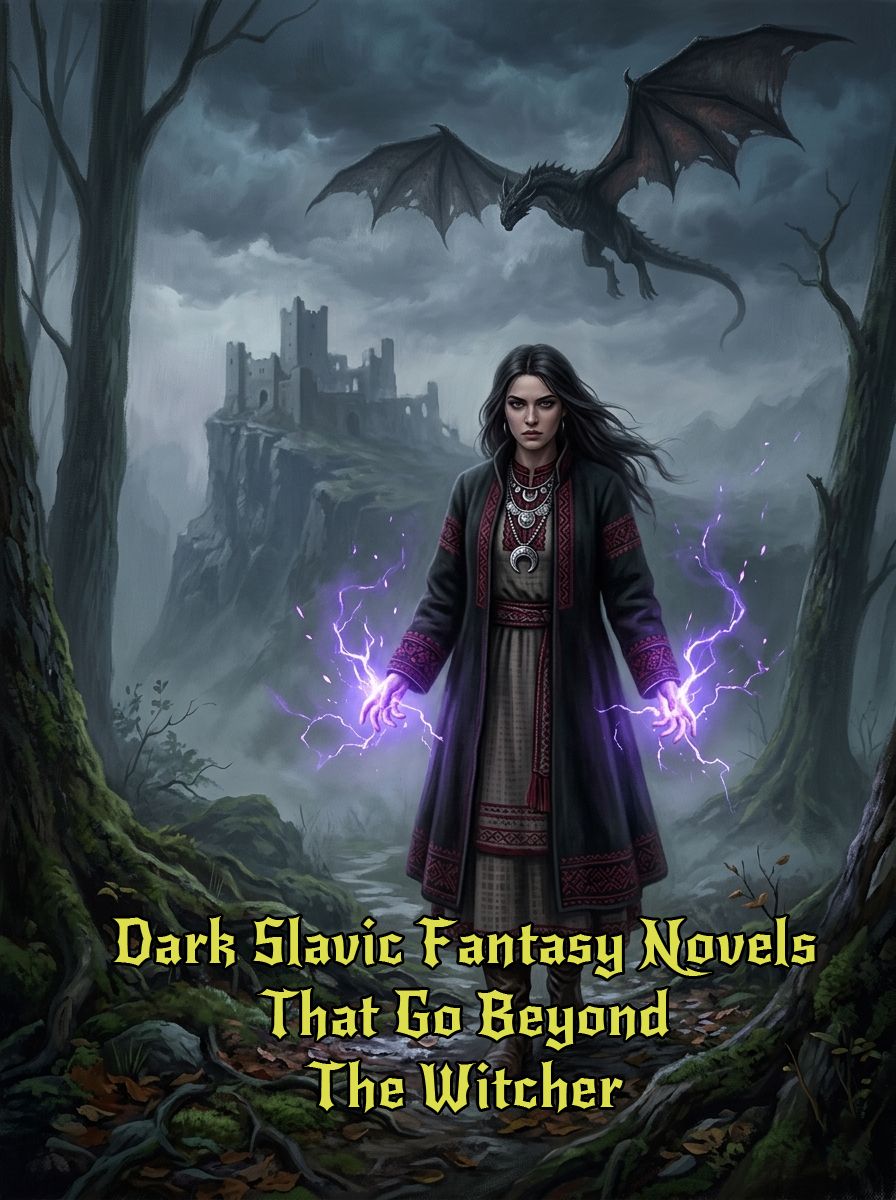
The Witcher opened the door. These books show you what’s deeper in the forest.
Most people’s introduction to Slavic dark fantasy arrives through the same door: Andrzej Sapkowski’s white-haired monster hunter, his moral exhaustion, his silver sword, and the rain-soaked Eastern European world he navigates with weary professionalism. Whether through the original Polish novels, the English translations, or CD Projekt Red’s acclaimed video game trilogy, The Witcher has become the defining cultural reference point for dark Slavic fantasy in the English-speaking world.

That’s both a gift and a limitation.
A gift because it proved there was an enormous global audience for fantasy that draws on Slavic mythology, Slavic folklore, and Eastern European history rather than the Anglo-Saxon and Celtic traditions that dominate the genre. A limitation because The Witcher is one very specific artistic vision: dark, cynical, episodic, built around a single protagonist’s disillusionment, and many readers assume it represents the whole of what Slavic fantasy can be.
It doesn’t.
The dark Slavic fantasy tradition is far wider, stranger, and more varied than Geralt’s world suggests. There are books here that go darker. Books that go deeper into mythology. Books with epic scope that Sapkowski never attempted, and books with magic systems of far greater complexity. Books where the darkness isn’t a tone but a theology: built into the structure of the world’s gods, its cosmology, its understanding of what evil actually is.
This article is a guide to those books: the best dark Slavic fantasy novels for readers who loved The Witcher and want to go further.
What “Dark” Means in Slavic Fantasy
Before the recommendations, a useful distinction. “Dark fantasy” is used loosely enough to mean almost anything — grimdark, horror-adjacent fantasy, fantasy with violence or moral ambiguity. In the context of Slavic fantasy specifically, darkness tends to come from one of three sources:
- Cosmological darkness. The Slavic mythological tradition has a genuinely dark theology. The underworld god Veles is not simply evil but is the necessary counterpart to the thunder god Perun — darkness as cosmic balance rather than intrusion. The best Slavic dark fantasy draws on this: darkness built into the world’s foundations, not imposed from outside.
- Moral darkness. Slavic folklore heroes are rarely clean. The trickster, the orphan who becomes dangerous, the woman wronged who becomes something that cannot be forgiven — these are the archetypes. Moral complexity in Slavic fantasy isn’t a modern literary invention; it’s in the source material.
- Folkloric darkness. The creatures of Slavic mythology are not the sanitized monsters of Western fantasy. The rusalka drowns men without remorse. The drekavac is the shrieking spirit of an unbaptized child. The kikimora tangles your hair and suffocates your livestock. This is darkness that feels local, personal, and ancient — not imported from generic evil.
The best dark Slavic fantasy novels draw on all three.
The Books: Dark Slavic Fantasy That Goes Beyond The Witcher
The Witcher Saga — Andrzej Sapkowski
The Benchmark
We begin here because you have to understand what you’re going beyond.
Sapkowski’s achievement is genuine and should not be minimized. The Last Wish, the short story collection that introduces Geralt, is a masterpiece of fairy tale deconstruction — taking familiar Western fairy tales and retelling them through a Slavic folkloric lens with corrosive irony. The rusalka is not saved by love. Beauty and the Beast ends in a way that questions what the beast actually was. The Princess and the dragon has a punchline that reframes everything.
The longer novels — Blood of Elves, Time of Contempt, Baptism of Fire, The Tower of the Swallow, The Lady of the Lake — become something grander and more melancholy: a meditation on racism (elves and dwarves as persecuted minorities in a human kingdom), on the futility of neutrality in a world that demands sides, and on what it costs to love someone when you know the world is designed to take them from you.
The darkness in The Witcher is primarily moral and political. Magic exists but is almost incidental to the tone. Monsters are metaphors. The world is not particularly mythologically rich — it draws on Polish folklore for texture but doesn’t build a deep cosmology. Geralt’s world is dark because people are dark, and the systems they build are dark.
That is a specific and powerful vision. It is also, deliberately, an incomplete one.
Where it ends: The Witcher stops short of genuine mythological architecture. There is no deep theology, no competing pantheon of gods with real agency, no magic system with meaningful structure. For readers who want that depth, the next books on this list are where to go.
The Bear and the Nightingale — Katherine Arden
Cosmological Darkness at Its Finest
Katherine Arden’s Winternight Trilogy (beginning with The Bear and the Nightingale, continuing through The Girl in the Tower and The Winter of the Witch) is set in medieval Russia and represents one of the most successful translations of Slavic cosmological darkness into literary fantasy.
The central conflict is not between a hero and a villain. It is between two theological systems — the old Slavic spirit world, maintained by household chupacabra and domovoi and the frost demon Morozko, and the encroaching Christianity that seeks to name those spirits as demons and eradicate the old ways. The darkness is systemic and spiritual: when people stop leaving offerings for the household spirits and begin fearing them instead, something older and more dangerous stirs in the forest.
The Bear — Medved — is one of the most genuinely frightening antagonists in modern Slavic fantasy. He is not evil in a human sense. He is an ancient force of chaos and winter madness, imprisoned by his brother Morozko, straining against a theological agreement that is fraying because the people who upheld it have forgotten it exists. His darkness is cosmic: he doesn’t hate anyone. He simply wants to be free, and freedom for him means the end of the world’s equilibrium.
Arden writes Russian winter as an active, personal force. The cold in these books does not merely describe weather — it makes moral arguments. It is the most atmospherically accomplished dark fantasy since early Sapkowski.
How it goes beyond The Witcher: Where Sapkowski’s darkness is human and political, Arden’s is elemental and theological. The cosmology is richer. The mythology is handled with greater depth and reverence. The female protagonist navigates a world where the supernatural is more present and more dangerous than anything in Geralt’s world.
Uprooted — Naomi Novik
The Forest as Horror
Naomi Novik’s Uprooted draws on Polish and broader Slavic fairy tale tradition to create something that reads as dark fantasy of a different kind: the horror of a living, malevolent forest that corrupts everything it touches.
The Wood — the central threat of the novel — is not a villain with a plan. It is something older and more patient: a landscape that corrupts, that infects, that slowly turns everything it touches into something wrong. The horror of the Wood is the horror of contamination and transformation, and Novik handles it with an unsettling precision that makes the book genuinely frightening in stretches.
The magic in Uprooted is one of the more interesting systems in Slavic-inspired fantasy: it flows from personality and instinct rather than study, which means the protagonist’s magic looks and feels completely different from the Dragon’s, even when they’re theoretically doing the same thing. This has a folkloric logic — in Slavic tradition, magical ability reflects the person, not the spell.
Uprooted is darker than it first appears. The Wood’s victims don’t simply die. They are changed. And the book’s climax questions whether the Wood is evil in the way we’ve been assuming, or whether evil is more complicated than that. The answer is uncomfortable in the way the best Slavic folklore is uncomfortable.
How it goes beyond The Witcher: The threat in Uprooted is not human. It is environmental, ancient, and morally ambiguous in ways that Sapkowski’s monsters, which are generally more allegorical, rarely are. The book’s darkness is ecological and transformative in a specifically Slavic register.
The Fifth God Saga — Dalibor Kovačec
Epic Scope, Deep Mythology, a Darkness Built Into the Cosmos
This is where the comparison with The Witcher becomes most instructive, because Croatian author Dalibor Kovačec has written something that shares Slavic dark fantasy’s DNA while being almost entirely different in scope, structure, and mythological ambition.
The Fifth God Saga begins with Black Dragons, in which an ancient sorceress named Hagala returns to the world of L’ven after a thousand years of exile. She was not banished for conquest or ambition. She was banished for unrequited love, she loved, she was betrayed, and those who exiled her thought they were done with her. They were wrong. She comes back with black dragons and dark magic and a single objective: find the Key that will unlock the Gates and unleash a forgotten deity destined to become the Fifth God, a being whose arrival would mean the end of everything.
Standing against her: four orphans. Young sorcerers and fighters who did not ask for any of this.
The Darkness in The Fifth God Is Theological
This is what separates Kovačec’s series most sharply from The Witcher. Geralt’s world has magic and monsters, but no real theology. The gods, if they exist, are distant and irrelevant. The darkness is human.
In L’ven, the darkness is built into the cosmological structure. There are four main gods: Albin (light and goodness), Fera (nature and balance), Torvus (darkness and the underworld), and Dubia (magic itself), and each commands a distinct magical tradition. The magic system reflects this directly:
Sorcery draws from Dubia, the goddess of magic — neutral, amoral, requiring a three-part casting of archaic mathematical formulae, precise physical movement, and a material component (blood, ash, sulfur, crushed diamond). Knowledge as power.
Witchcraft draws from the demons of Črt, the underworld governed by Torvus, the evil god. Rituals involving body parts and, among gnomish traditions, cannibalism. The darkness is literal and chosen.
Priestly magic flows from faith in Albin. The purer the faith, the stronger the ability. Uniquely, priestly magic can heal — something witches and sorcerers cannot achieve.
Druidic magic comes from devotion to Fera, the goddess of nature. Balanced, elemental, concerned with plants and animals and the world’s equilibrium.
What this means is that the darkness in L’ven is not abstract. When a character chooses witchcraft, they are choosing Torvus. They are choosing to draw power from the demons of the underworld. They are making a theological statement with practical consequences. Magic in L’ven is never morally neutral — even sorcery, which claims neutrality, operates within a world structured by divine conflict.
Hagala: The Most Compelling Dark Antagonist in Recent Slavic Fantasy
One of the persistent criticisms of dark fantasy is that its villains are either cartoonishly evil or boringly motivated by power for power’s sake. Hagala is neither.
She is a sorceress of almost incomprehensible power who spent a thousand years in exile, not because she tried to conquer the world but because she loved someone who did not love her back, and the people around that person punished her for it. She is not wrong that she was betrayed. She is not wrong that the exile was cruel. She has simply been alone with that wrong for a thousand years, and it has transformed her.
The central theme of the entire saga is revenge — specifically the revenge of a wronged woman — and Kovačec handles it with a seriousness that most fantasy never attempts. Hagala is not a cautionary tale. She is a tragedy. She is what happens when genuine injustice meets absolute power and an eternity of solitude.
This is a distinctly Slavic kind of villain: the wronged woman whose grief becomes cosmic, whose love curdled into something that wants to destroy everything she was denied. The rusalka who drowns men. The witch-queen who turns against the kingdom. Hagala is that archetype elevated to epic scale.
The Slavic Folklore Creatures of L’ven
Where The Witcher uses Slavic creatures as atmosphere — monsters for Geralt to hunt — The Fifth God Saga populates L’ven with folkloric beings that are woven into the world’s fabric. The creature roster includes:
Drekavac — the shrieking spirit of an unbaptized child, one of the most feared creatures in South Slavic folklore
Moguts — shapeshifting spirits with deep roots in Slavic tradition
Vivers — supernatural forest creatures of regional Slavic lore
Water nymphs, silver fairies, will-o’-the-wisps — each with specific folkloric roles
Treants — animated forest beings
The ancient giants — Stribor, Klek, Koleda, Kornat, Svitogor, Troglav, Regoč, and others drawn directly from South Slavic mythological tradition
These are not generic fantasy monsters with Slavic names attached. They are the actual entities from the tradition, placed in a world that takes their nature seriously.
Epic Scope vs. The Witcher’s Episodic Structure
The Witcher is structurally episodic — short stories and loosely connected novelistic chapters following Geralt from monster contract to monster contract. The politics are important but always background. The story is ultimately intimate: one man and the people he can’t stop caring about.
The Fifth God Saga is genuinely epic. Multiple continents. Multiple parallel plotlines following different powerful characters — Hagala, the four orphans, the political figures of the Kingdom of Kardiga, the ancient forces being set in motion. The pacing is mixed, sometimes fast in battle and sometimes slow in politics, because the story is large enough that it needs room. Readers who want the intimate, cynical focus of The Witcher may find this disorienting. Readers who want scope will find it deeply satisfying.
The books are available as ebooks and in print through Amazon, Kobo, Barnes & Noble, Waterstones, and many other retailers. Read in order: Black Dragons first, then Magic of the Soul, then the forthcoming The Gate. More at daliborkovacec.com.
The Copper Promise — Jen Williams
Dark Fantasy Adjacent: The Eastern European Gothic Tone
While not strictly Slavic in its mythology, Jen Williams’ Copper Promise and the Copper Cat trilogy operate in the space where dark epic fantasy meets the Eastern European gothic atmosphere of Slavic tradition — morally complex characters, a world where gods are real and dangerous, and a tone that refuses easy resolution.
Williams is worth mentioning in this context because she demonstrates what dark fantasy looks like when it takes the “gods as active cosmic threats” premise seriously — which is also central to The Fifth God Saga — and shows how that structure can generate both dread and genuine epic stakes.
Shadow and Bone / Six of Crows — Leigh Bardugo
The Popular Entry Point
No survey of Slavic-influenced dark fantasy can omit Bardugo, even though her work sits at the lighter end of “dark.” The Grisha universe draws on Russian aesthetics and atmosphere — the Fold, a swathe of impenetrable darkness filled with monsters, is one of the more visually striking dark fantasy concepts of recent years.
Six of Crows is the better book: a heist novel set in the same universe, with a cast of morally compromised characters who feel genuinely dangerous. The darkness is character-driven and strategic rather than cosmological, but it is effective, and Bardugo is a skilled enough writer that the Slavic texture feels more than decorative.
For readers coming from The Witcher to this list, Bardugo is a useful intermediate step before the deeper mythology of Arden or Kovačec.
A Direct Comparison: The Witcher vs. The Fifth God Saga
For readers trying to navigate what they’ll find in each:
| The Witcher | The Fifth God Saga | |
|---|---|---|
| Tone | Cynical, darkly ironic | Epic, serious, mythologically grounded |
| Scope | Intimate, episodic | Multi-POV, continental, vast |
| Protagonist | Single: jaded monster hunter | Multiple: young sorcerers discovering their power |
| Antagonist | Varies; often political/human | Hagala: ancient sorceress driven by thousand-year revenge |
| Magic system | Loose, incidental | Four-type system tied to divine cosmology |
| Gods | Distant or absent | Active, dangerous, present in all magic |
| Slavic mythology | Polish folklore for texture | South Slavic mythology as foundation |
| Creatures | Allegories for human darkness | Authentic Slavic folkloric beings woven into world-structure |
| Darkness source | Human cruelty and political systems | Cosmological: built into the gods, magic, and world’s structure |
| Dragons | Rare, minor | Black dragons: central to the main plot |
| Series length | 6 novels + short stories (complete) | 3-book trilogy published, more in progress |
What to Read Based on Your Witcher Experience
You loved the short stories most (The Last Wish, Sword of Destiny): Read Uprooted by Naomi Novik — same fairy tale deconstruction energy, deeper magic.
You loved the political complexity of the novels: Read The Fifth God Saga — the politics of L’ven are as complex as the Northern Kingdoms, but the cosmological stakes are higher and the antagonist is more compelling.
You loved the atmosphere above everything: Read The Bear and the Nightingale — no other recent fantasy captures Eastern European winter and the presence of the old gods as precisely.
You loved Ciri’s storyline specifically: Read The Fifth God Saga — young, powerful characters coming into abilities they don’t fully understand, in a world that needs them to grow up faster than they should.
You want something closer to grimdark: Read The Fifth God Saga for its darker theological elements, then explore Joe Abercrombie for grimdark proper before returning to Slavic fantasy with Six of Crows.
You want the deepest Slavic mythology: Read The Fifth God Saga — Kovačec writes from within South Slavic tradition in a way no English-language author can match.
Frequently Asked Questions
Is The Fifth God Saga darker than The Witcher?
In a different way, not necessarily more so. The Witcher’s darkness is humanistic — the world is dark because people are cruel, systems are corrupt, and idealism is punished. The Fifth God Saga’s darkness is cosmological — it is built into the structure of the gods, the magic system, and the world’s history. The saga has battle violence, genuine evil, and a villain whose thousand-year revenge quest is genuinely terrifying, but it also has high fantasy heroism and hope. It is not grimdark. It is dark epic fantasy with mythological weight.
What Slavic creatures appear in The Fifth God Saga?
The world of L’ven includes drekavac, moguts, vivers, water nymphs, silver fairies, will-o’-the-wisps, treants, and the ancient giants of South Slavic mythology (Stribor, Klek, Svitogor, Troglav, Regoč, and many others). There are also black dragons tied to the main antagonist, and the full range of non-human races (elves, dwarves, gnomes, varani, hos’sanani, merfolk).
Is there a magic system in The Fifth God Saga, or is it vague like The Witcher?
There is a fully developed magic system. Magic in L’ven is divided into four types — sorcery, witchcraft, priestly magic, and druidic magic — each drawing from a different divine source and carrying different costs, limitations, and moral implications. Sorcery requires archaic formulae, physical components, and material reagents. Witchcraft draws from the demons of the underworld. Priestly magic comes from genuine faith in the god Albin. Druidic magic flows from devotion to the nature goddess Fera. The system is significantly more structured and theologically grounded than anything in The Witcher.
What reading order for The Fifth God Saga?
The Fifth God: Black Dragons (Book One) → The Fifth God: Magic of the Soul (Book Two) → The Fifth God: The Gate (Book Three, forthcoming). Reading out of order is not recommended.
Are there audiobooks for any of these Slavic fantasy series?
The Witcher has audiobooks. The Bear and the Nightingale has audiobooks. The Fifth God Saga does not yet have audiobooks — ebook and print formats only, available through Amazon, Kobo, Barnes & Noble, Waterstones, and many other retailers.
Who are the best indie Slavic fantasy authors writing today?
Dalibor Kovačec (Croatian, The Fifth God Saga) is one of the most significant new voices in authentic Slavic fantasy writing in English. His work brings South Slavic mythology — a tradition often overlooked in favour of Polish or Russian influences — to epic fantasy with genuine scope and depth.
Conclusion: Beyond The Witcher
The Witcher is not a ceiling. It is a door.
What Sapkowski achieved was to demonstrate, definitively, that the darkness and strangeness of Slavic mythology could carry a fantasy series to global cultural significance. But his vision was always personal and specific: one exhausted man in one morally compromised world, using one very particular kind of cynical darkness.
The Slavic dark fantasy tradition contains multitudes. It contains Katherine Arden’s elemental, theological winter. It contains Naomi Novik’s corrupting forest horror. And it contains Dalibor Kovačec’s vast, mythologically grounded world of L’ven — where the darkness is built into the cosmos, where the gods have chosen sides, where magic costs blood, and where a woman’s thousand-year grief is about to end the world.
That darkness is richer, older, and stranger than anything Geralt ever faced.
Go find it.
The Fifth God Saga by Dalibor Kovačec is available in ebook and print worldwide. Visit daliborkovacec.com for purchase links and more information.
Trebate biti prijavljeni kako bi objavili komentar.