
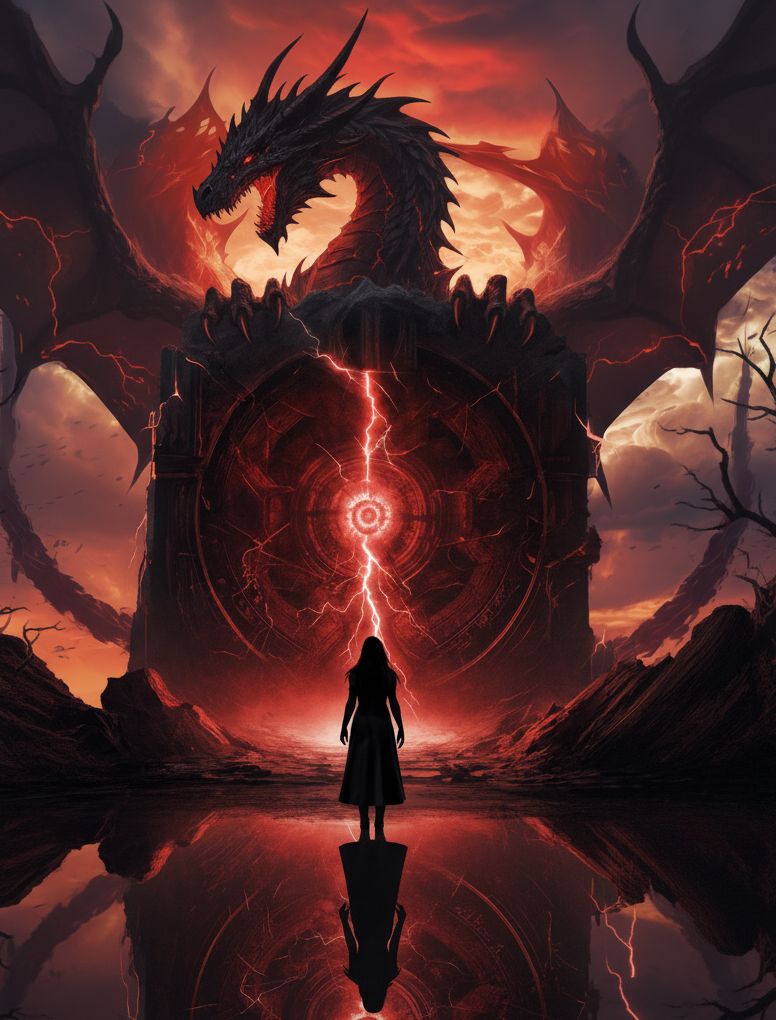

There is a particular kind of story that hits differently when you’re deep into it at midnight, when the battle scenes make your blood race and the romantic tension makes it impossible to put the book down. That story sits at the crossroads of fantasy romance for men, raw, violent, emotionally charged, and unapologetically ambitious. That is exactly what I set out to write when I created The Fifth God saga, and it is what I want to talk about here: why the intersection of epic fantasy and deep romantic longing is some of the most powerful storytelling in the genre, and why it deserves far more recognition than it gets.

Fantasy Romance Is Not a Soft Genre
Let’s dismantle something right away. Fantasy romance for men doesn’t look like a softened epic with flowers added to the cover. It looks like two people, both carrying impossible power, impossible burdens, and impossible histories, finding each other in a world that is actively trying to kill them. In The Fifth God: Black Dragons, the first book in my saga, four orphans bound by old friendship return to the place where they grew up, only to be pulled into a war between kingdoms, dragons, and a millennia-old sorceress with a vendetta. Love doesn’t arrive gently in this world. It arrives the way everything does in L’ven, through fire.
The Villain Who Started it All With a Broken Heart
What makes the romantic element of The Fifth God saga unusual is that it begins not with the heroes, but with the antagonist. Hagala is a thousand-year-old sorceress, exiled from the world she once called home, seething with the kind of rage that only comes from unrequited love combined with betrayal. She brings black dragons back to the world. She seeks a dark artifact that could open a gate for a god of destruction. She wants to burn everything down. And the seed of all that catastrophe? A love that was never returned. I wrote Hagala this way deliberately, because I believe that desire, thwarted, weaponized, or transformed, is one of the most honest engines of any story. Her pain is not decorative. It is the axis around which the entire saga rotates.
Love Triangles in a World That Wants You Dead
In Magic Of The Soul, the second book in the series, the romantic stakes grow sharper and more personal. Under the command of Emperor Uto, an army of griffon riders, undead warriors, and black dragons ravages the continent. In the middle of that apocalyptic backdrop, two lovers dream of marriage while noble families conspire to tear them apart. That tension, the private war inside a larger war, is something I find endlessly compelling to write, and I believe it is something that resonates deeply with readers who want their fantasy to carry genuine emotional weight. Yes, there are love triangles in The Fifth God saga. They are not there for drama’s sake. They exist because powerful people attract powerful feelings, and because the world of L’ven does not make choices easy.
When Magic and Desire Become Inseparable
One of my favorite aspects of fantasy romance for men is the way magic and emotional vulnerability become entangled. In The Fifth God saga, I follow a young wizard struggling with dark, forbidden magic that threatens to consume him. His journey inward, guided by a mysterious mentor, discovering powers he didn’t know he carried, mirrors what happens emotionally when someone falls for another person. Magic in this world is intimate. It comes from within. When a character’s soul is on the line, and so is their heart, the stakes stop being abstract and become deeply human. Magic Of The Soul, the book’s very title, says everything about where I was trying to take the second installment of the series.
The Men Who Fight and the Men Who Feel
Epic fantasy has a long tradition of celebrating physical courage, knights, warriors, mages who can level mountains. What it sometimes neglects is the interior life of those men. I was influenced by authors like R.A. Salvatore, whose Drizzt character carries profound loneliness and longing beneath all the swordplay, and by Andrzej Sapkowski, whose Geralt is defined as much by his emotional complications as by his monster-hunting. The Fifth God saga is built in that same spirit. My characters earn their power. They also earn their love, their heartbreak, and their desire. The romance in this story is not handed to anyone. It is fought for, complicated by politics and ancient evil, and sometimes lost. That is what makes it matter.
Slavic Myth as the Backdrop for Desire
I am a Croatian author, and the world of L’ven, where The Fifth God saga takes place, is shaped by Slavic mythology in ways I find difficult to fully explain without giving too much away. Ancient gods, forgotten deities, pacts made before recorded history. This mythology has a particular quality to it: it is earthy, brutal, and strangely tender. The way desire and death sit next to each other in Slavic folk tradition maps onto epic fantasy with unusual power. When a character in my books falls in love, it happens against a backdrop of genuine mythological weight, not decorative world-building, but a cosmology that has its own logic and its own hunger. That context changes everything about how romantic emotion lands on the page.
Why “Enemies to Lovers” Doesn’t Exist in L’ven
I want to mention something specific about my approach to fantasy romance: I made a deliberate choice to exclude the “enemies to lovers” trope from The Fifth God saga. It simply does not fit the structure of this world or these characters. I find that trope often cheapens both the conflict and the romance, you end up with neither a convincing enemy nor a convincing lover. In L’ven, the characters who fall for each other do so because of genuine connection, shared danger, and the kind of trust that can only be built under pressure. The romances in Black Dragons and Magic Of The Soul are not built on the reversal of hatred. They are built on something harder and more interesting to write: the slow, complicated process of two strong people choosing each other in a world that offers them every reason not to.
This Is What Fantasy Romance for Men Actually Looks Like
The third book, The Gate, is in progress, and it will close many of the storylines begun in Black Dragons, including romantic ones that have been building across two volumes. But the world of L’ven will not end with it. It is too large, populated by too many powerful individuals whose stories are still unresolved. What I can tell you is that everything I’ve built in this saga, the magic, the dragons, the political intrigue, the mythological architecture, exists in service of a story about people who want things. Power, yes. Survival, absolutely. But also connection. Also love. Also the terrifying vulnerability of letting someone matter to you when the world is on fire. That is fantasy romance for men at its most honest: not a concession to softer sensibilities, but the acknowledgment that desire and danger have always belonged together, and that the best epic fantasy has always known this. The Fifth God saga knows it too.
Trebate biti prijavljeni kako bi objavili komentar.