
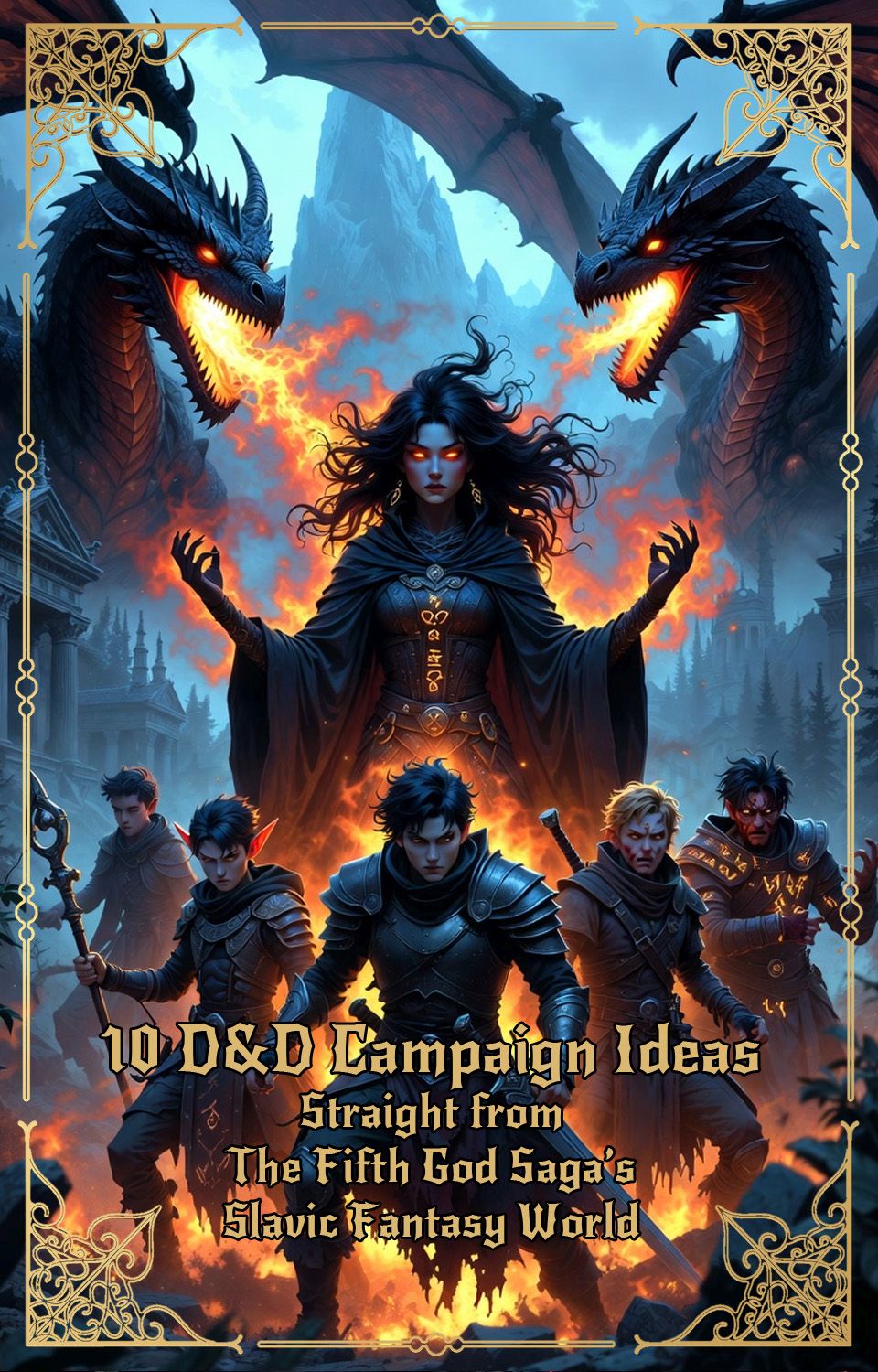
The Fifth God saga draws deeply from the spirit of tabletop roleplaying games like Dungeons and Dragons, blending structured magic, party dynamics, epic quests, and moral choices into a rich Slavic-inspired fantasy world. While not LitRPG with levels or stats, the series feels like a long-running D&D campaign brought to life on the page, complete with a diverse adventuring party, intricate world-building, high-stakes battles, and gods who toy with mortals like players rolling dice on fate.
If you’re a Dungeon Master hunting fresh inspiration or a player craving stories that echo your table sessions, here are 10 D&D campaign ideas pulled straight from The Fifth God Saga’s world of L’ven. Each one is ready to adapt into your next Dungeons and Dragons or TTRPG game, infused with dark Slavic mythology, blood-paid magic, and subversive tropes.

- The Exiled Sorceress Returns (Long-Term Villain Arc)
A powerful spellcaster, banished centuries ago for betrayal and forbidden love, breaks free and unleashes black dragons to conquer the land. Her goal: locate an ancient Key to summon a forgotten chaotic deity, the Fifth God, threatening total annihilation.
D&D Campaign Hook: Your party discovers old prophecies about her return. Early sessions involve investigating ruined temples, clashing with dragon cultists, and racing rival factions to the Key. Twist: The villain has legitimate grievances, forcing players to question if stopping her dooms an unjust world. Perfect for a multi-year D&D campaign with escalating stakes.
- The Reluctant Chosen One (Subverted Prophecy)
A street-hardened orphan carries mysterious artifacts and receives cryptic visions, yet stubbornly rejects being “the Chosen One.” Allies see destiny in him, but he believes negotiation trumps fate, leading to exhausting political entanglements.
D&D Campaign Idea: One PC is the reluctant hero (or an NPC ally). Prophecies emerge piecemeal; the party debates whether to force destiny or let free will prevail. Include sessions of court intrigue, failed diplomacy, and moments where the “chosen” risks everything to prove prophecies wrong. Great for character-driven TTRPG play.
- Blood-Paid Sorcery & Material Components (Magic System Overhaul)
Sorcery demands precise mathematical formulas (spoken in archaic tongues), intricate gestures, and costly components like sulfur, diamond dust, blood, or cremated crow ash. Casting isn’t free, overuse risks madness or physical toll.
Dungeons and Dragons Inspiration: Homebrew a Vancian-like system with real costs. Wizards track “blood debt” or component scarcity. Sessions revolve around risky rituals, scavenging rare ingredients during heists, or moral dilemmas (using ally blood?). Ideal for gritty, resource-management-focused campaigns.
- Four Gods & Divine Patrons (Cleric, Druid, Warlock Alternatives)
L’ven’s pantheon includes Albin (goodness/light/healing via faith), Fera (nature balance via devotion), Torvus (evil/demons via dark rituals, including cannibalism), and Dubia (pure magic without worship). Sorcerers draw inherently from Dubia; witches pact with Torvus’s underworld.
TTRPG Campaign Seed: Players choose divine patrons with unique mechanics. A Torvus warlock risks demonic possession for power; an Albin cleric heals but faces church politics. Include faction wars between churches, druid groves, and witch covens. Add a “Fifth God” as an endgame eldritch horror.
- The Unlikely Orphan Party (Adventuring Group Origin)
Four orphans from brutal streets and battlefields rise as unlikely saviors: a young sorcerer battling inner darkness, a pragmatic negotiator, and others forged in hardship. Their unbreakable friendship drives the quest against world-ending threats.
D&D Campaign Idea: Start characters as low-level orphans in a chaotic city. Early adventures build bonds through survival heists, druidic duels, and shared trauma. As levels rise, they confront armies and black dragons. Emphasize loyalty, betrayal shatters the group. Classic “found family” trope for emotional Dungeons and Dragons tables.
- Slavic Myth Monsters & Bestiary Expansion (Creature Encounters)
L’ven teems with Slavic-inspired beings: drekavac (screaming demons), moguts (giant ogre-like brutes), treants, dryads, will-o’-the-wisps, ancient giants (Stribor, Troglav, etc.), wyverns, griffins, and terrifying black dragons born from ancient wars.
Fantasy Inspired by Dungeons & Dragons: Import these into your bestiary. A forest session features drekavac hunts; mountain treks pit the party against giants. Black dragons as intelligent, empire-building tyrants add political layers. Use for horror-tinged wilderness crawls or boss fights.
- Political Feudal Kingdoms & Faction Intrigue (Domain Play)
The Kingdom of Kardiga (feudal, with hard-to-govern Dragonia county) clashes with caliphate alliances, elven forests, dwarven holds, lizardfolk varani tribes, and hos’sanani (big-cat humanoids with meritocratic-democratic roots). The Church of Albin wields massive influence.
D&D Campaign Hook: Mid-campaign shifts to domain-level play. Players ally with nobles, navigate Church politics, broker peace between races, or spark rebellions. Include crystal-ball spying, raven messengers, and magical Letter-Casters for communication flavor.
- Moral Gray Choices & Ethical Dilemmas (Alignment Challenges)
Heroes question every kill, does stopping Hagala justify collateral deaths? Antagonists act from twisted ethics; prophecies mislead; visions drive nations mad if ignored.
TTRPG Inspiration: Build sessions around tough decisions: sacrifice an innocent for greater good? Ally with a demon-pacting witch against dragons? Use fallout mechanics where choices haunt PCs (guilt, curses, lost allies). Perfect for mature groups exploring gray morality.
- Multi-Continent Epic Quest Arc (Travel & Exploration)
L’ven spans two continents: Mediterranean-like coasts in Kardiga/Dragonia, hot deserts, icy mountains, swamps, and more. Armies march, Gates tremble, and ancient sites hold secrets.
Dungeons and Dragons Campaign Structure: Design a hex-crawl or point-crawl across regions. Sessions involve sea voyages with mermaids, desert ruins, mountain giant lairs. Climax at trembling Gates where heroes decide the world’s fate. Great for year-long epics.
- Gods as DM-Style Players (Metaplot & Cosmic Stakes)
The four gods treat mortals as pieces in a grand game. Hagala’s revenge seeks to upend the board by awakening the Fifth God of Chaos.
Fantasy Inspired by Dungeons & Dragons: Frame divine intervention as “DM fiat” with consequences. Clerics receive omens; druids sense Fera’s displeasure. Endgame reveals gods’ rivalries. Players might confront divine avatars or bargain with gods directly.
These ideas capture what makes The Fifth God Saga feel like a living D&D campaign: deep character arcs, costly magic, diverse races, Slavic-flavored monsters, political depth, and epic revenge quests with moral weight. The series, starting with The Fifth God: Black Dragons (where Hagala returns, black dragons ravage, and orphans rise) and continuing in Magic of the Soul (deepening relationships amid empire-building chaos), delivers the narrative payoff your table craves after dice stop rolling.
If you’re a Dungeons and Dragons fan seeking fantasy novels that echo your sessions, dive into The Fifth God Saga. Grab a free sample or start Book 1 today at The Fifth God saga. Your next campaign inspiration, and gripping read, awaits in the blood-soaked world of L’ven.
Trebate biti prijavljeni kako bi objavili komentar.