
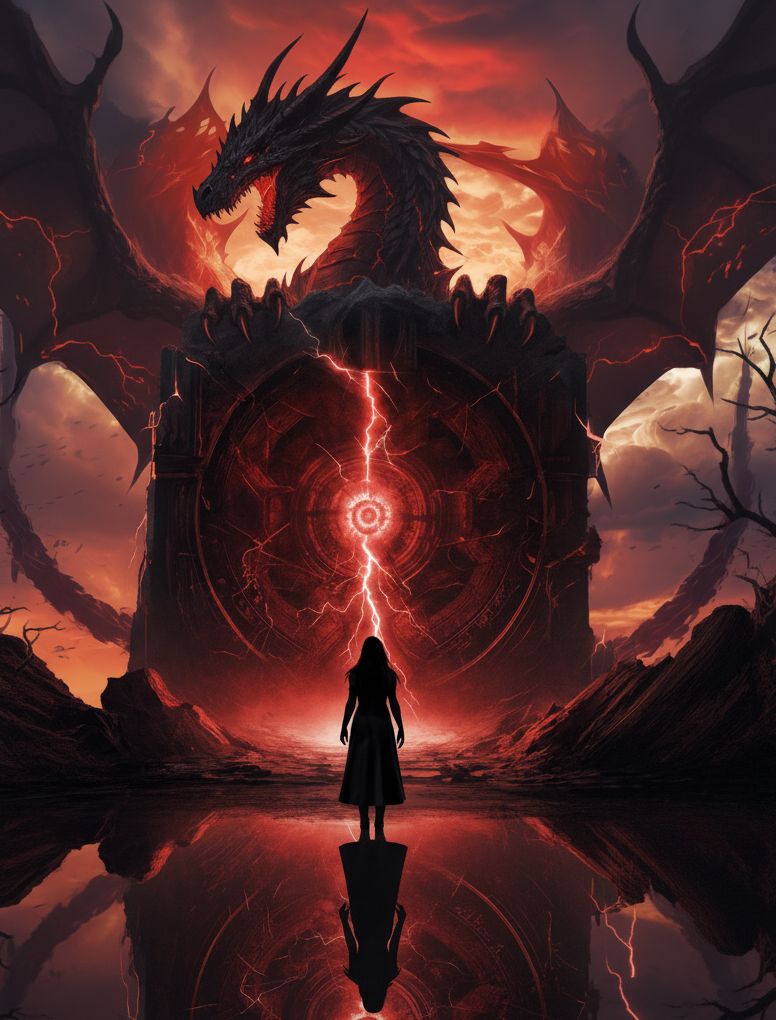

There’s a moment in The Fifth God: Black Dragons where everything a great fantasy story promises converges into a single beating heart, dragons scorching the sky, kingdoms crumbling under siege, and two people standing at the edge of an impossible war, choosing each other anyway. I wrote that scene because I believe it with every fiber of my craft: the most powerful stories are never just about battles or magic systems or prophecies. They are about desire. Longing. The terrifying, exhilarating decision to love someone when the world is literally on fire around you.

That is the soul of fantasy romance for men, not a softened, sanitized version of the genre, but the raw fusion of steel and feeling that has driven storytelling since Homer sent Achilles into grief over Patroclus. Epic fantasy romance is not a subgenre for one kind of reader. It is the oldest kind of story there is.
When the Stakes Are Highest, So Is the Heart
One of the things I was determined to do when I built the world of L’ven, the continent where The Fifth God saga unfolds, was make sure the romantic stakes matched the apocalyptic ones. In Magic of the Soul, two lovers dream of a future together while an empire of undead warriors, griffon riders, and black dragons tears the continent apart. Their enemies are not abstract. The threat to their relationship is not a misunderstanding or a rival at a ball. It is an army. It is a sorceress who has spent a thousand years sharpening her hatred into a weapon. That tension, love fighting to survive inside catastrophe, is what makes fantasy romance for men land differently than in quieter genres.
The reason is simple: high-stakes fantasy gives emotional stakes somewhere to breathe. When a character risks death every other chapter, when kingdoms fracture and gods scheme in the shadows, a stolen moment between two people becomes charged with something almost sacred. You feel the weight of it because you know what it costs.
The Villain Who Loved Too Much
Here is something I confess freely as an author: my most compelling character is my antagonist. Hagala, the sorceress at the center of The Fifth God saga, is a woman fueled entirely by the wreckage of unrequited love. She was exiled from L’ven a thousand years ago, not for malice, but for passion that consumed everything around it. When she returns in Black Dragons, she brings black dragons, dark artifacts, and an army bent on opening a gate for a god of destruction. And yet, the central theme of the entire saga is not power or prophecy. It is revenge born from heartbreak.
This is why fantasy romance for men hits hardest when it refuses to be simple. Hagala is not a monster because she was born evil. She is a monster because she loved deeply, was betrayed, and had a millennium to decide what to do about it. The question her arc forces on every reader, male, female, anyone, is genuinely uncomfortable: how far does love, twisted into grief, actually reach? What does it cost a world when someone powerful enough to change it decides it is no longer worth saving?
Four Orphans, Unbreakable Bonds, and the Women Who Complicate Everything
The four protagonists of The Fifth God are, at their core, a story about friendship, orphans bound by loyalty who stumble into becoming the only force capable of stopping Hagala’s plan. That male companionship, the kind forged on streets and in hardship before any quest ever begins, is a dynamic I find criminally underused in modern fantasy. There is genuine brotherhood in these books, the kind that does not require explanation or justification. It simply exists, tested, broken, repaired, and ultimately made stronger by everything the world throws at it.
But friendship alone does not sustain a saga of this scope. Around these four men grow love interests, love triangles, political marriages, forbidden desires. These are not decorative subplots. They drive decisions. A young wizard torn between his forbidden, dark magic and the woman he cannot stop thinking about makes different choices because of her. A warrior fighting to survive a brutal siege carries the face of the person he loves as both anchor and wound. Fantasy romance for men works when love is not a reward at the end of the journey, it is a weapon, a wound, a reason to fight, and sometimes the thing that nearly destroys a man before it saves him.
Magic, Mythology, and the Architecture of Desire
Part of what makes the world of L’ven uniquely suited to stories about passion and longing is how deeply it is saturated with Slavic mythology. The dragons, wyverns, and griffins are expected. But treants, water nymphs, drekavac, moguts, will-of-the-wisps, ancient giants with names like Svitogor and Koleda, these are not borrowed from the same Northern European well that most Western fantasy draws from. They are Eastern European, rooted in older soil, carrying different emotional freight.
I drew on this mythology deliberately. There is something about Slavic folklore’s relationship to fate, cycles of vengeance, and the supernatural that mirrors the emotional landscape of fantasy romance for men in a way I find deeply satisfying. Hagala’s magic, sorcery built on mathematical formulas spoken in archaic languages, on physical ritual, on material sacrifice, feels earned. Love in The Fifth God feels earned the same way. Nothing comes for free. Every feeling has a cost, a component, a consequence.
The Chosen One Who Doesn’t Believe It
Janosh, the central protagonist of the saga, is not a hero who wanted the job. Growing up an orphan hardened on the streets, he is direct, practical, and deeply skeptical of the prophecies that seem to orbit him. Characters around him, and eventually readers, begin to suspect that something larger has shaped his path. He does not believe it. He finds politics exhausting, manipulation repugnant, and the idea that he was born for a destiny somewhat absurd.
This is, paradoxically, exactly what makes him magnetic in a romantic context. His simplicity, a word I use with full admiration, means that when he feels something, he does not have elaborate courtly strategies for expressing it. He has himself: stubborn, honest, occasionally baffled by how complicated other people insist on making things. Fantasy romance for men often thrives on this archetype: the capable, unadorned man who has no idea how to navigate the emotional landscape he suddenly finds himself in, and chooses honesty over artifice every time. The romance that grows around Janosh in Black Dragons and deepens in Magic of the Soul works because it is never cynical. In a world full of gods scheming and sorceresses plotting and empires colliding, his directness is almost radical.
Love Triangles and the Politics of the Heart
I mentioned love triangles earlier, and I want to address them directly because they carry a reputation they sometimes do not deserve. In The Fifth God saga, the triangles are not manufactured drama. They arise from the political and social architecture of L’ven itself. Noble families conspire against young lovers not out of cruelty but out of calculation, alliances, bloodlines, power. The tragedy is that love in a feudal world is never purely private. It exists inside systems that have opinions about it.
This gives fantasy romance for men a texture that purely personal love stories cannot achieve. When love is political, its obstacles feel real, not contrived. When someone chooses a person over a dynasty’s expectations, the cost is measurable, the sacrifice visible. In Magic of the Soul, the question of whether two people can actually build a life together while an emperor’s undead armies and black dragons are systematically destroying the continent is not rhetorical. It is urgent. Every scene between them matters more because the world is actively trying to prevent it.
Why the Genre Needs Stories Like These
Fantasy romance for men has always existed. It existed in the Iliad and the Aeneid. It existed in Arthurian legend. It existed in every great sword-and-sorcery tale where a warrior fought not only for survival but for something more specific and more precious. What has changed is the willingness to name it clearly, to say that emotional depth and romantic tension are not accessories to the epic quest. They are the engine.
When I started writing The Fifth God saga, I was thinking about the stories that had gripped me: the worldbuilding density of Brandon Sanderson, the unflinching grit of Joe Abercrombie, the mythic creature-craft of R.A. Salvatore’s Drizzt series and Margaret Weis and Tracy Hickman’s Dragonlance novels. What I wanted to add, what I felt was missing for me as a reader and therefore as a writer, was that the love had to matter as much as the magic. The longing had to be as precisely constructed as the dragon attacks. Hagala’s thousand-year grief had to be felt, not just catalogued. That ambition is what drives the Fifth God saga across its three books, Black Dragons, Magic of the Soul, and the forthcoming The Gate, and it is, I believe, the ambition that the best fantasy romance for men has always carried.
The blade is only half the story. The burning desire is where it becomes legend.
The Fifth God: Black Dragons and The Fifth God: Magic of the Soul are available on Amazon, Barnes & Noble, Bookshop.org, Walmart, and many other retailers worldwide. Start reading Black Dragons for free on Wattpad. Visit daliborkovacec.com for more.
Trebate biti prijavljeni kako bi objavili komentar.