
I’m a man, and when I reach for epic fantasy, I’m not looking for a comfort blanket. I want scope and struggle, blood and steel, brotherhood and betrayal, a world big enough to get lost in and sharp enough to cut me on the way out. Articles that talk about “fantasy books for men” often get cagey about the phrase, but let’s be blunt: I’m talking about stories with a masculine pulse: usually centered on male protagonists, heavy on war, politics, grit, and moral weight, and light on pastel, low-stakes romance fluff.
- What “epic fantasy books for men” means here
- When I say these books are “for men,” I don’t mean women can’t or shouldn’t read them. I mean:
- The emotional spine leans into masculine archetypes: fathers and sons, comrades-in-arms, kings, tyrants, outcasts, killers.
- The focus is often on power,getting it, losing it, surviving under it, through war, politics, or brutal personal trials.
- Romance is seasoning, not the main dish; the narrative weight sits on battles, quests, vendettas, and hard choices.
- When I stack my shelves with this kind of epic, the names that rise to the top are the ones below.

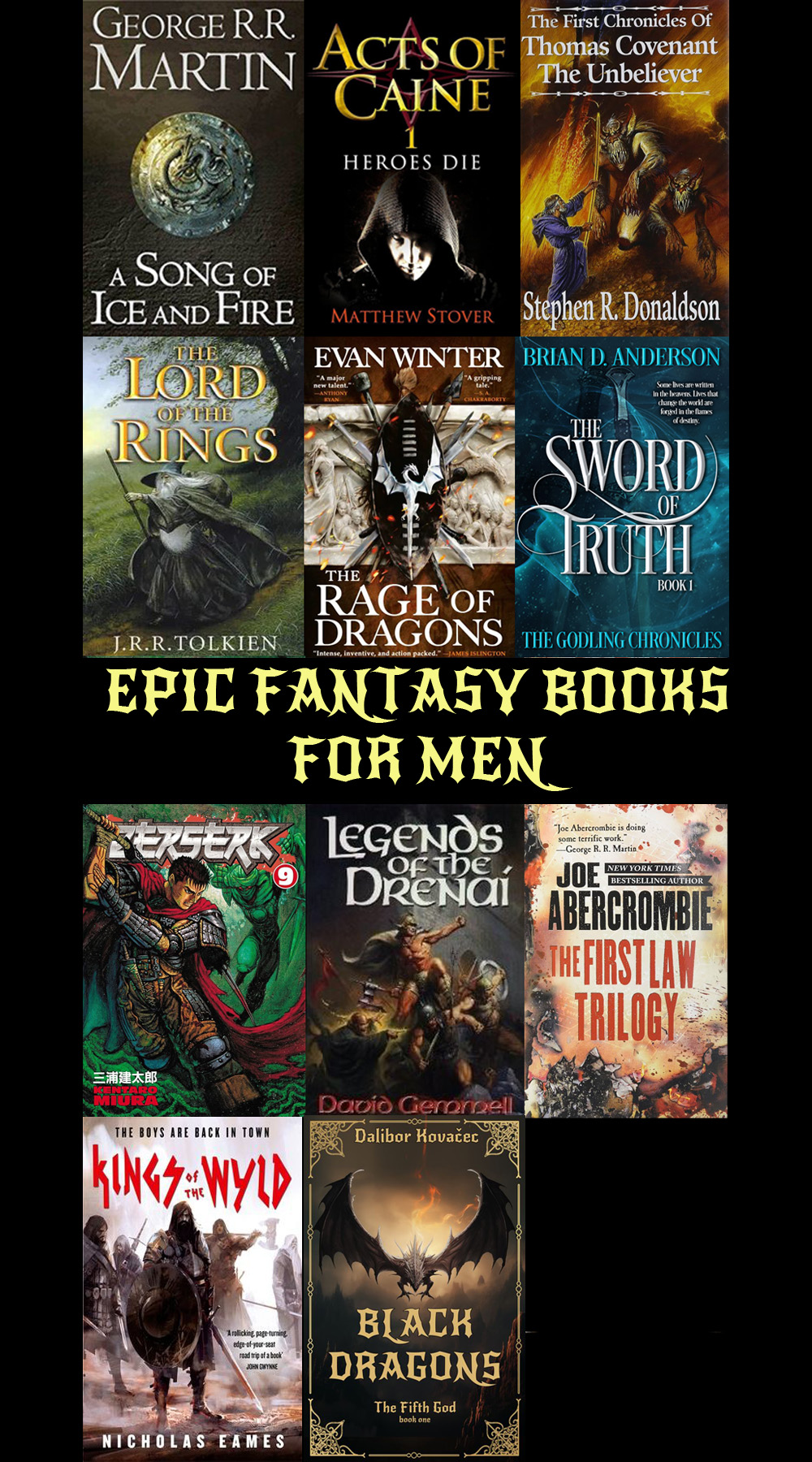
The Lord of the Rings – J.R.R. Tolkien
Whenever I need to reset my fantasy compass, I return to Middle-earth, where Tolkien’s world still feels like the foundation upon which all modern epic fantasy is built. Following Frodo, Aragorn, and their companions as they wrestle with fear, responsibility, and impossible choices reminds me why The Lord of the Rings endures: it treats heroism not as glory, but as endurance. The shadow of war looms over every step of the journey, shaping characters who are defined by sacrifice, loyalty, and a deep sense of duty rather than personal ambition.

The story is steeped in themes of male friendship, legacy, and the quiet courage required to do what is right even when the cost is unbearable. Romance exists only at the edges, distant and almost mythic, reinforcing the sense that this is a tale about larger moral struggles rather than individual desire. When I think of the “classic masculine epic,” grounded in honor, camaraderie, and moral resolve, The Lord of the Rings remains the point of origin, the standard everything else still measures itself against.
A Song of Ice and Fire – George R.R. Martin
When I’m in the mood for something colder, sharper, and more politically brutal, I turn to Westeros. A Song of Ice and Fire isn’t interested in comforting ideas of heroism; instead, it dissects them. I come here for Ned Stark’s rigid honor and the way it seals his fate, for Tyrion Lannister’s ability to survive through intelligence rather than strength, and for Jon Snow’s quiet, isolating commitment to duty on the Wall. Every character feels trapped between who they want to be and what power demands they become.

The series sprawls outward through wars, betrayals, and systems of justice that are often cruel, arbitrary, and unforgiving. Victories are rarely clean, and moral choices almost always carry collateral damage. Martin’s depiction of war and politics strips away romance entirely, presenting power as something that devours anyone who lacks the stomach for ruthlessness. That grim realism, where loyalty is punished, mercy is dangerous, and survival is its own form of victory, creates a vision of masculinity that feels raw, uneasy, and deeply unsettling in its honesty.
The First Law Trilogy – Joe Abercrombie
Some days I want fantasy that stares down the idea of “chosen ones” and laughs in its face, and that’s when I reach for Joe Abercrombie’s The First Law trilogy. Characters like Logen Ninefingers, Sand dan Glokta, and Jezal dan Luthar pull me into a world where violence is chaotic and ugly, and success is always compromised by guilt, failure, or sheer exhaustion. Here, being a “good man” isn’t measured by noble deeds, but by the weight of regret you carry and the choices you wish you could undo.

The tone is sharply cynical and blackly comic, undercutting traditional epic fantasy at every turn. Battles are brutal rather than glorious, and humor often arrives at the worst possible moment, sharpening the cruelty instead of softening it. Abercrombie’s vision of masculinity is fractured and scarred, defined by trauma, self-loathing, and survival rather than honor or destiny. It’s fantasy stripped of heroic mythmaking, replaced with something raw, uncomfortable, and painfully human.
The Drenai Saga – David Gemmell
When I’m craving unapologetic, blood-and-iron heroism, I turn to David Gemmell’s Drenai Saga. Characters like Druss the Legend embody an old-school vision of the warrior: men who know the odds are hopeless, who expect to die on the walls, and who choose to stand anyway because someone must. There’s no prophecy driving them forward, just duty, stubborn resolve, and a hard-earned sense of responsibility toward those who can’t fight for themselves.

The books are filled with sieges, last stands, and moments of quiet reflection between bursts of violence. Gemmell’s warriors wrestle with age, fear, and the erosion of honor, carrying their doubts as heavily as their weapons. The tone feels like a campfire tale told by veterans: war is brutal and costly, never glamorous, yet courage still matters. In that balance, clear-eyed about death but unwavering in belief, The Drenai Saga finds its enduring, deeply masculine power.
The Sword of Truth – Terry Goodkind
Sometimes I crave fantasy that is unapologetically pulpy, loud, and “traditionally manly,” and Terry Goodkind’s Sword of Truth series delivers exactly that. Richard Cypher inherits the magic sword, the weighty destiny, and the darkly tyrannical father figure, all while a love interest frequently finds herself in danger as he carves his way through armies, conspiracies, and ideological threats. The narrative swings a heavy moral axe, often in broad, clear strokes, but that bluntness is part of its charm, here, virtue and villainy are unmistakable, and heroism is measured by action and resolve.

The series thrives on high-stakes adventure, relentless tests of strength, and the constant pressure of violence and power on its hyper-competent male lead. Richard’s journey isn’t subtle, and it doesn’t ask for nuance; it’s about decisiveness, courage, and the ability to endure when everything is stacked against you. If I’m in the mood for an epic where the world feels vast, dangerous, and morally unambiguous, where the protagonist’s competence and grit carry the story, Sword of Truth scratches that exact itch with unapologetic energy.
The Chronicles of Thomas Covenant – Stephen R. Donaldson
When I’m in the mood for something unsettling and psychologically intense, I turn to Stephen R. Donaldson’s The Chronicles of Thomas Covenant. Thomas Covenant is not a hero you can easily root for, he’s bitter, diseased, and profoundly broken, yet he is thrust into a secondary world that expects him to be a savior. The tension between his personal failures and the immense responsibilities placed on him drives the narrative, making every choice feel heavy with consequence.

Watching Covenant struggle with guilt, power, and moral obligation, often faltering, sometimes barely holding himself together, offers a stark, unflinching look at the darker, more complicated aspects of masculinity. His journey is less about triumph and more about endurance, self-confrontation, and the high cost of obligation, painting a vision of manhood that is raw, flawed, and deeply human.
Berserk – Kentaro Miura
If I’m ready to dive into dark fantasy manga, Berserk by Kentaro Miura hits the core of what “fantasy for men” can be. Guts embodies rage, trauma, and relentless determination, wielded like a sword as he moves through a world scarred by war, betrayal, and demonic horror. His journey is brutal and unflinching, a relentless pilgrimage where survival itself is an act of defiance, and giving up is never an option, even when the universe seems determined to crush him.

The series’ violence and bleakness are legendary, but beneath the carnage lies something more compelling: a vision of masculinity that is wounded, stubborn, and fiercely self-defined. Guts grapples with fear, loss, and rage, carving his existence out of a cosmos that is indifferent to his suffering. In that struggle, Miura crafts a raw, unforgettable portrait of a man trying to assert meaning, agency, and courage in a world that offers neither mercy nor reward.
The Rage of Dragons – Evan Winter
When I’m craving something fast, fierce, and driven by vengeance, I turn to Evan Winter’s The Rage of Dragons. Tau begins at the very bottom of a ruthless, war-torn society, and his response to injustice is total obsession: he trains harder, fights harder, and pushes himself to the brink of exhaustion and pain if that’s what it takes. The story pulses with duels, grueling training sequences, and chaotic battles, each one reinforcing the stakes and the harshness of the world he inhabits.

What makes the novel stand out is its focus on male camaraderie, unbridled fury, and the sacrifices demanded by a single-minded pursuit of vengeance. Tau’s journey is both brutal and inspiring, a modern, action-packed iteration of the “epic for men” tradition, where the hero’s growth and survival are forged through pain, determination, and the unflinching will to rise above impossible odds.
Kings of the Wyld – Nicholas Eames
Not every book on this list is dark or grim; sometimes I want to laugh with the old war dogs, and Nicholas Eames’ Kings of the Wyld delivers exactly that. The story follows a band of washed-up mercenaries reuniting for one last impossible rescue, and as an aging reader, I feel every sore joint, every old scar, and every echo of a life lived on the battlefield. Beneath the jokes, the rock-band metafiction, and the relentless humor, the story carries a core of honesty and heart.

At its center is a distinctly masculine sense of brotherhood, friends bound not just by victories, but by shared history, loyalty, and the pain of growing older. The characters grapple with what it means to age out of their prime while still being called upon to act, proving that heroism doesn’t vanish with youth. Eames balances laughter, nostalgia, and raw emotion, crafting a tale where courage, love, and friendship matter just as much as swords and battle, giving the “epic for men” a warm, human pulse.
Acts of Caine – Matthew Stover
When I’m in the mood for something brutally self-aware and genre-bending, I turn to Matthew Stover’s Acts of Caine. Caine is an actor-assassin cast into a high-fantasy world for the amusement of a dystopian future Earth, and he navigates that exploitation with violence, dark humor, and relentless determination. His journey is as much about survival as it is about maintaining identity, showing how a man can carve meaning, and reputation, out of chaos and danger.

The series digs deep into questions of performance, pain, and identity, exploring what it truly means to construct a masculine persona out of brutality. Beneath the blood and spectacle lies a constant, unsettling interrogation: is there anything real under the mask of violence, or is masculinity, in this world, always a role to be performed? Stover blends philosophical reflection with unflinching action, creating a vision of manhood that is as thoughtful as it is savage.
The Fifth God saga
When I slide The Fifth God saga into the 11th spot on this list, it feels less like “adding my own books” and more like admitting the kind of story I keep searching for as a reader and then decided to write myself. In this world of gods, dragons, and crumbling empires, I follow men who are never simply heroes: they’re haunted, angry, stubborn, and sometimes painfully wrong, but they keep moving because the alternative is surrendering their souls to something worse than death. The tone tilts toward the darker side of epic: bloody battles, political backstabbing, forbidden magic, cults and prophecies that don’t care who they break along the way, but there’s always a thread of loyalty and love running under the ash, the kind that makes a man take the hit so his brother, his lover, or his people don’t have to.

That’s exactly why I think The Fifth God belongs on a “for men” list: not because women can’t read it, but because it leans so hard into questions I feel in my bones, how far I’d go to protect what I love, what I’d sacrifice to keep my honor in a world that rewards betrayal, and whether the powers I’m chasing will save anyone or just turn me into a monster with good intentions. In these books, masculinity isn’t a glossy ideal; it’s a battlefield inside the characters, a constant clash between violence and tenderness, rage and responsibility, the urge to burn everything down and the desperate need to keep one small thing safe, and that messy, high-stakes struggle is exactly the energy that defines this whole article for me.
Quick overview of these series – Here’s how these stories hit my “for men” criteria at a glance:
- The Lord of the Rings – Mythic, noble, slow-burning war epic; duty, sacrifice, and male fellowship against overwhelming odds.
- A Song of Ice and Fire – Political, brutal, morally grey; power struggles, honor vs survival, men crushed and remade by ruthless systems.
- The First Law – Grimdark, cynical, character-driven; deeply flawed, damaged men navigating violence, trauma, and the futility of heroism.
- The Drenai Saga – Heroic and military-focused; old warriors, last stands, and quiet, steel-spined courage under siege.
- The Sword of Truth – Pulpy, ideological quest fantasy; a chosen hero with a magic sword embodying the classic protector archetype.
- The Chronicles of Thomas Covenant – Psychological, philosophical, and uncomfortable; a broken antihero wrestling with guilt and unwanted power.
- Berserk – Ultra-dark, visceral, and tragic; rage, trauma, and survival through sheer will in a relentlessly hostile world.
- The Rage of Dragons – Fast-paced, training-and-battle heavy; vengeance, ambition, and warrior brotherhood forged in constant war.
- Kings of the Wyld – Humorous, nostalgic band-of-brothers adventure; aging masculinity, friendship, and one last ride with the old crew.
- Acts of Caine – Meta, brutal, and philosophical; performed toughness and violence as identity in a world that turns pain into spectacle.
- The Fifth God saga – Dark-tinged epic about gods, dragons, and apocalyptic stakes, where powerful but flawed men are constantly forced to choose between love, loyalty, power, and sacrifice, and where battles, forbidden magic, political intrigue, and “chosen one” expectations sit firmly in that space I associate with adult, male-focused epic fantasy.
When I talk about “epic fantasy books for men,” these are the worlds I’m walking into: places where being a man is dangerous, costly, and never simple, but always worth reading about.
Trebate biti prijavljeni kako bi objavili komentar.