
As a writer and editor who has spent decades navigating the shifting tides of epic fiction, I’ve watched a fascinating evolution in how we approach the “hero’s journey.” For a long time, the industry treated romance as a side quest, something for the protagonist to achieve after the dragon was slain. But the modern reader, especially young men looking for depth, understands that a blade is only as sharp as the conviction behind it. When I look at the landscape of fantasy romance for men, I see a demand for stories where the emotional stakes are just as lethal as the physical ones, and where the bond between characters is the literal difference between salvation and the abyss.

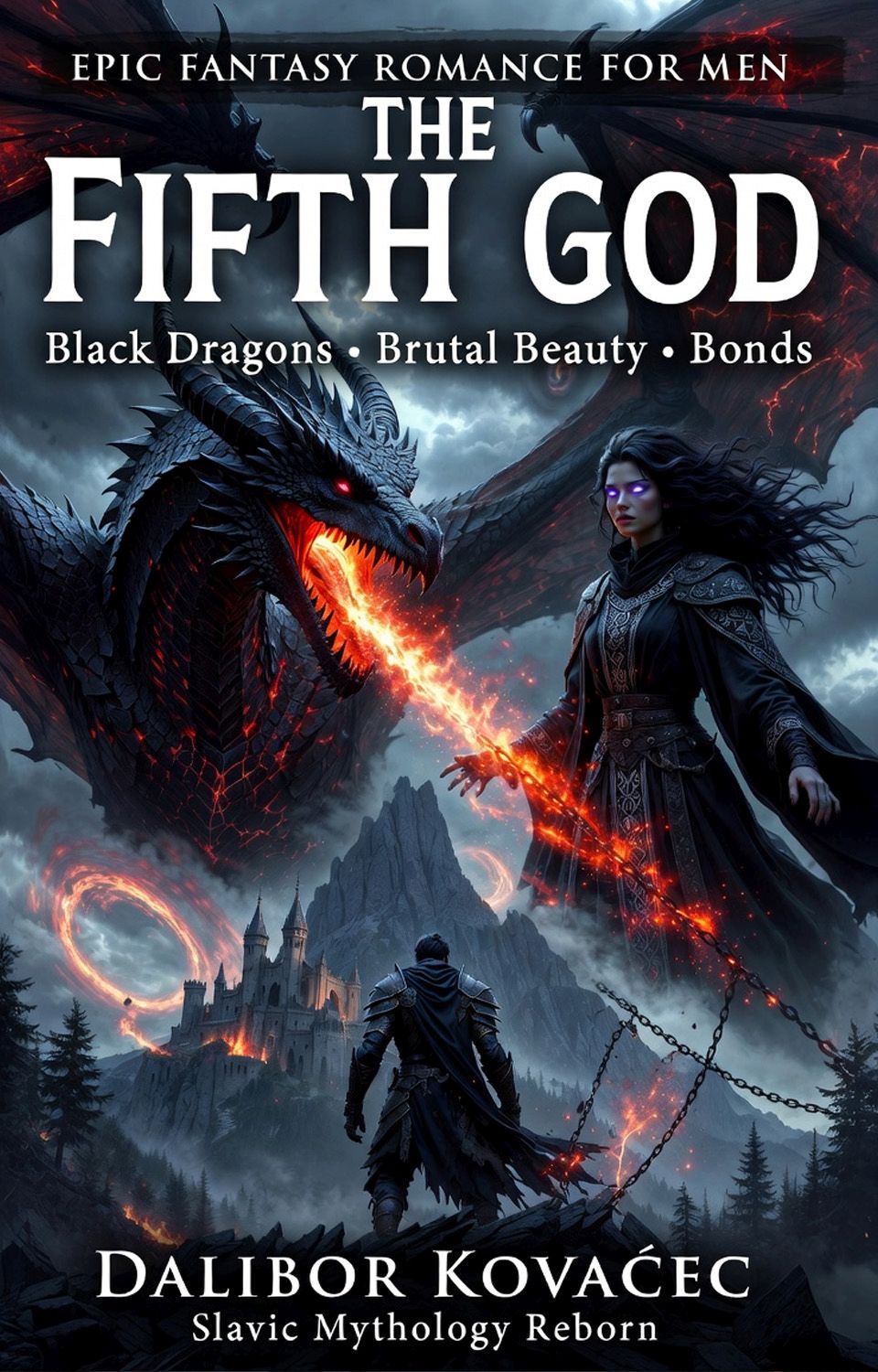
In my experience, the most resonant stories are those that ground high-stakes magic in the raw reality of human devotion. This is exactly what I aimed to capture in The Fifth God saga, specifically in Black Dragons. We follow four orphans whose lives have been a relentless series of survival tests. Their connection isn’t a subplot; it is their armor. In a world where an ancient sorceress like Hagala returns with an army of undead and griffon riders, the romance isn’t about flowery prose, it’s about being the only person who can keep your partner from falling to the darkness of their own power.
The setting of The Fifth God draws heavily from Slavic mythology, a realm of folklore that is inherently grittier and more fatalistic than its Western counterparts. By rooting the narrative in the Kingdom of Kardiga and the continent of L’ven, the romance takes on a primal, urgent quality. Here, the gods are not benevolent observers; they are active, often malevolent players. When you are caught in the crossfire of a divine war, your loyalty to your partner becomes a revolutionary act. It is this “brutal beauty”, the light of a shared dream of marriage set against the shadow of a looming apocalypse, that defines the genre’s best work.
I’ve always believed that for a romance to feel authentic to a male audience, the characters must be tested through action. In Magic of the Soul, the second book of the series, we see a young wizard grappling with forbidden magic that threatens to consume his very essence. His struggle is solitary, yet his bond with those he loves provides the only tether back to humanity. This isn’t a “soft” romance; it’s a desperate, tactical struggle for the soul. The magic system itself, built on complex mathematical formulas and material costs like blood and ash, mirrors this weight. There are no free passes in L’ven, neither in sorcery nor in love.
One of the most compelling dynamics I’ve edited and written is the “scorned antagonist” trope, personified by Hagala. She is the shadow reflection of the protagonists. Her thousand-year quest for vengeance stems from a heart shattered by unrequited love and betrayal. By positioning her as the primary threat, the story highlights the dual nature of passion: it can either build a kingdom or, as Hagala intends, open the Gate for a god of destruction. It forces the heroes to realize that their own bonds must be stronger than the ancient bitterness that fuels their enemy.
Authenticity in fantasy romance for men also requires a certain level of tactical realism. Whether it’s a druid defending their title in a smoldering duel or knights navigating the political intrigues of noble families, the romance must exist within these pressures. In the world I’ve built, noble houses conspire to tear lovers apart for the sake of ancient alliances. This adds a layer of “us against the world” tension that elevates the story from a simple adventure to a high-stakes drama where every kiss is a defiance of a decree and every sword stroke is a vow kept.
The “grit” of the saga is further enhanced by the presence of the Black Dragons, creatures that are not just monsters to be slain, but harbingers of a shifting era. When an unstoppable army ravages the continent, the characters’ personal goals are stripped down to their most essential elements. We see this in Janosh the Mountain, a hero whose journey is rooted in finding the extraordinary within the ordinary. For him, the fight against Emperor Uto’s forces is personal. The love he carries isn’t a distraction from the war; it is the very reason he picks up the sword.
Ultimately, the reason we return to these sprawling epics is to see ourselves reflected in the impossible choices of the characters. We want the dragons, the undead legions, and the complex sorcery, but we also want a story that acknowledges that the most powerful magic is the one we find in another person. The Fifth God saga is my contribution to this tradition, a world where the bonds are unbreakable, the gods are terrifying, and the romance is as sharp and enduring as a dragon-forged blade.
Trebate biti prijavljeni kako bi objavili komentar.